





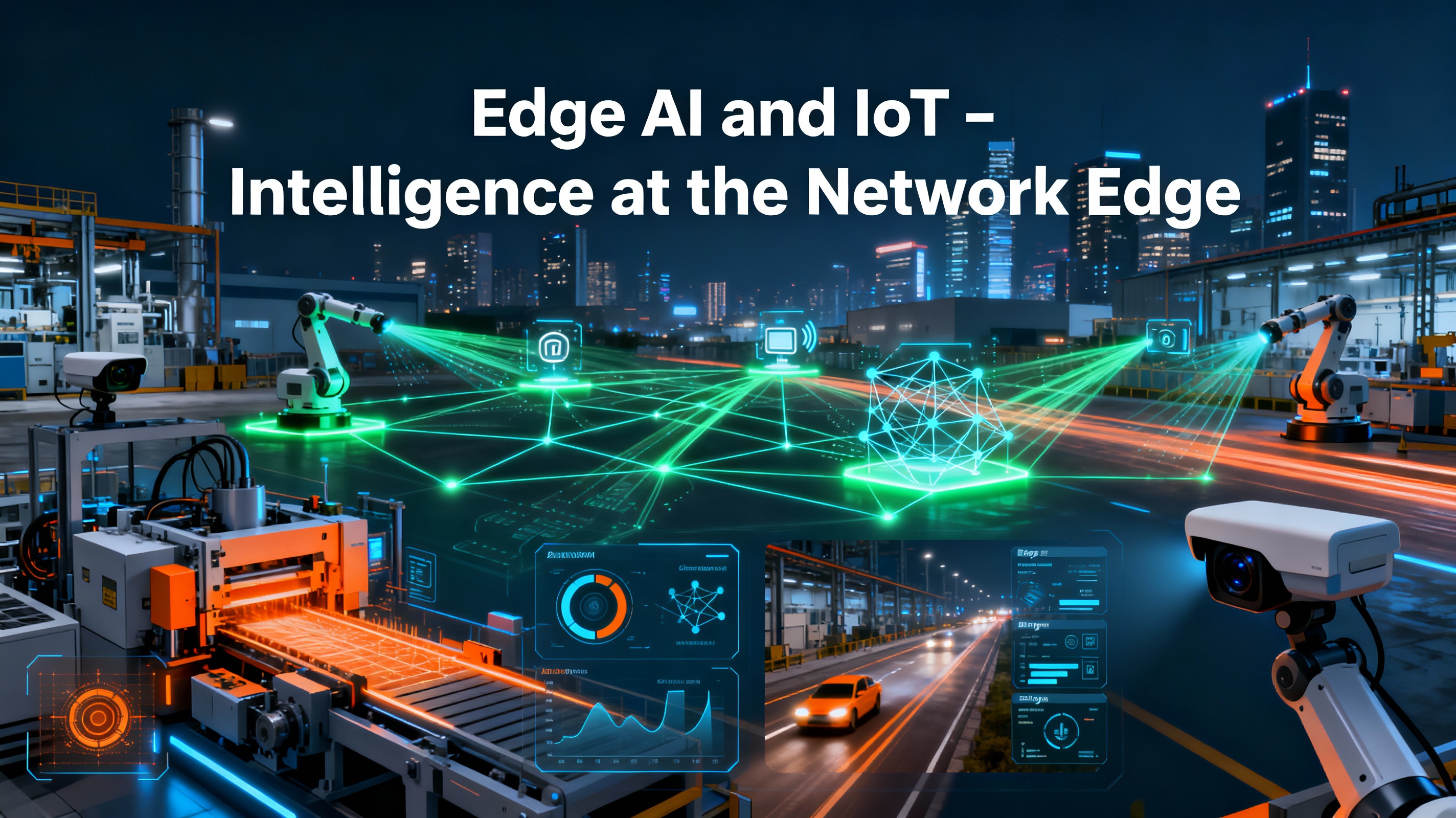
Edge artificial intelligence represents a fundamental shift in how AI systems operate, moving computation from centralized cloud servers to devices at the network edge. This architecture enables faster processing, enhanced privacy, reduced bandwidth consumption, and operation in environments with limited or no connectivity. As IoT devices proliferate and AI capabilities expand, edge AI is becoming increasingly essential.
The advantages of processing data locally rather than sending it to cloud servers are substantial. Latency drops from hundreds of milliseconds to mere microseconds, enabling real-time applications like autonomous vehicles, industrial automation, and augmented reality. This speed difference can be critical for safety and user experience in time-sensitive applications.
Privacy benefits of edge AI are particularly significant. When data processing occurs on-device, sensitive information need not be transmitted to external servers. Security cameras can analyze video locally, smart speakers can process voice commands without cloud transmission, and health monitors can analyze data without sharing it externally. This local processing addresses growing privacy concerns about cloud-based AI.
Bandwidth and infrastructure cost reductions make edge AI economically attractive. Sending continuous video streams or sensor data to the cloud for processing consumes enormous bandwidth. Local processing transmits only relevant insights, dramatically reducing data transmission requirements. For applications involving millions of devices, these savings multiply substantially.
Autonomous vehicles exemplify why edge AI is essential rather than optional. Self-driving cars cannot rely on cloud connectivity for split-second decisions. All perception, planning, and control must occur onboard with extremely low latency. The vehicles use powerful edge AI processors to run complex neural networks that interpret sensor data and make driving decisions in real-time.
Industrial IoT applications increasingly deploy edge AI for predictive maintenance, quality control, and process optimization. Smart factories use edge devices to monitor equipment, detect anomalies indicating potential failures, and optimize operations continuously. Processing data locally enables immediate responses to changing conditions without cloud round-trip delays.
Smart city infrastructure leverages edge AI for traffic management, public safety, and resource optimization. Intelligent traffic lights adjust timing based on real-time traffic flow. Security cameras detect incidents and alert authorities without streaming all footage to central servers. Environmental sensors monitor air quality and trigger responses to pollution events locally.
Healthcare monitoring devices use edge AI to analyze patient data continuously without cloud dependence. Wearable devices detect irregular heartbeats, monitor glucose levels, or identify falls, providing alerts immediately. This capability enables proactive health management and emergency response while protecting sensitive health information.
Agricultural IoT systems deploy edge AI for precision farming applications. Sensors monitor soil conditions, weather, and plant health across large farms. Edge processing identifies areas needing irrigation, detects pest infestations early, and optimizes growing conditions. This localized intelligence enables efficient resource use even in areas with limited connectivity.
Retail environments use edge AI for customer analytics, inventory management, and loss prevention. Smart shelves detect when products run low, cameras analyze customer behavior patterns, and checkout systems enable frictionless payment experiences. Processing this data at the edge improves response times while addressing privacy concerns about sending video to the cloud.
The technical challenges of edge AI differ from cloud deployments. Edge devices have limited computational power, memory, and energy compared to data centers. This constrains the complexity of models that can run efficiently. Developers must optimize models through techniques like quantization, pruning, and knowledge distillation to fit within edge device constraints.
Model updating and management across distributed edge devices present operational challenges. Deploying updated models to millions of devices, monitoring performance, and handling failures requires robust infrastructure. Federated learning approaches enable models to improve from edge device experiences while preserving privacy, but coordination complexity increases substantially.
Security concerns for edge AI devices are significant. These devices operate in Less controlled environments than data centers, making them vulnerable to physical tampering, network attacks, and adversarial inputs. Securing edge AI requires robust hardware security, encrypted communications, and adversarial robustness in models themselves.
The edge AI chip market is exploding as semiconductor companies develop processors optimized for neural network inference at low power. Qualcomm, Google, Apple, NVIDIA, and others offer specialized chips delivering impressive AI performance within edge device power and thermal constraints. These dedicated processors make sophisticated AI feasible on battery-powered devices.
5G networks complement edge AI by providing high-bandwidth, low-latency connectivity when cloud interaction is necessary. The combination enables hybrid architectures where edge devices handle time-critical processing while leveraging cloud resources for model updates, complex analysis, or aggregated insights. This flexibility optimizes the balance between local and cloud processing.
Standardization efforts aim to create interoperability across edge AI platforms. Organizations like the EdgeX Foundry and Linux Foundation Edge are developing open frameworks and standards. These efforts reduce fragmentation and enable developers to build applications that work across diverse edge devices and platforms.
Looking ahead, edge AI capabilities will continue expanding as more powerful and efficient processors become available. The integration of edge AI throughout IoT ecosystems will enable applications currently impractical or impossible. The challenge lies in managing complexity, maintaining security, and ensuring reliability across distributed systems comprising billions of intelligent edge devices operating in diverse, uncontrolled environments.









Comments & Discussion
Join the discussion by logging into your account.