

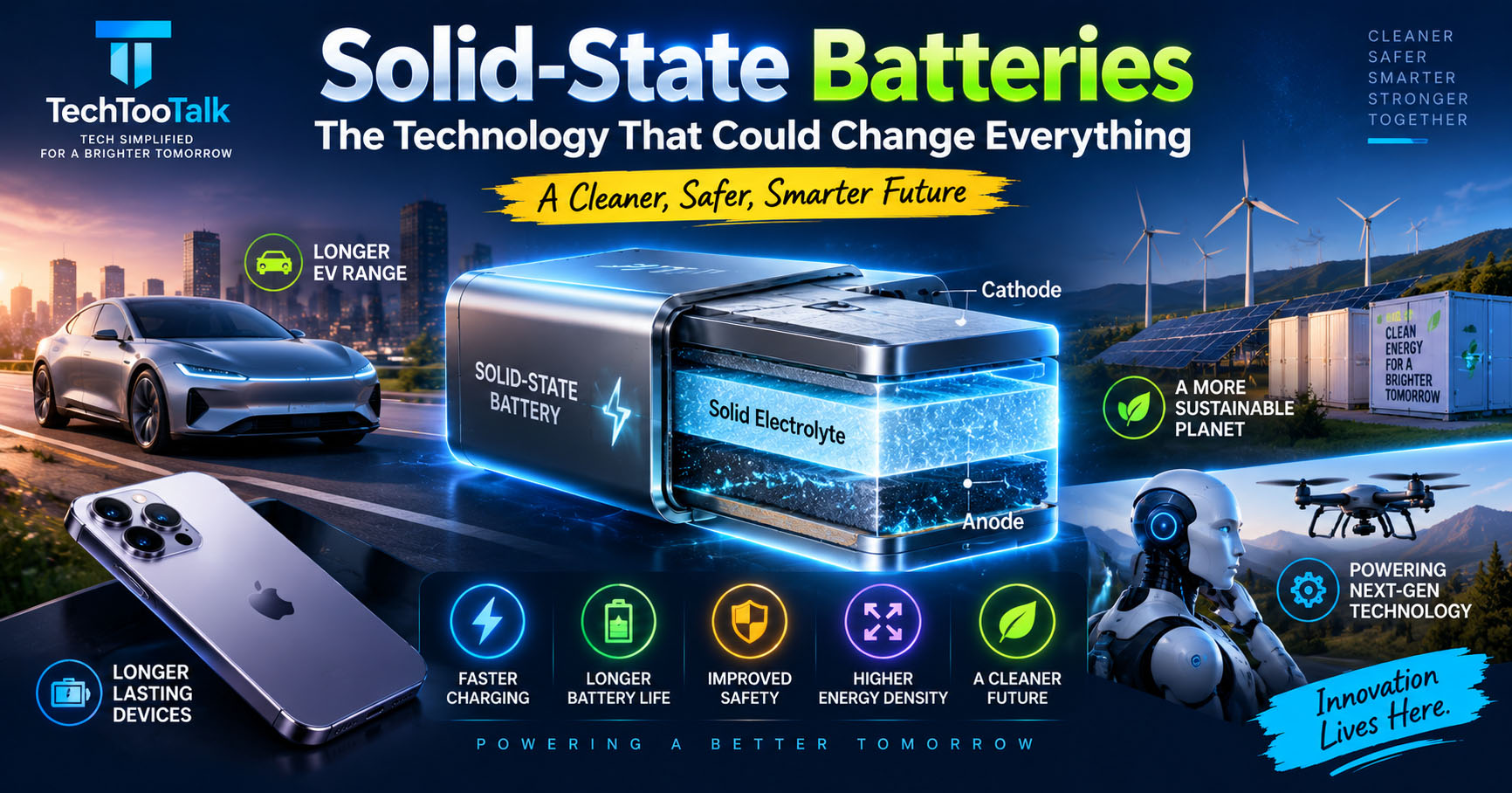
Solid-State Batteries: The Technology That Could Change Everything
Imagine an electric vehicle that charges faster, travels farther, and offers improved safety. Imagine smartphones that last significantly longer on a single charge. Imagine renewable energy storage becoming more efficient and reliable.
This future could be powered by one important technology:
Solid-State Batteries.
For decades, lithium-ion batteries have powered our smartphones, laptops, electric vehicles, and countless other devices. But as demand for better performance and cleaner energy continues to grow, researchers and technology companies are searching for the next major breakthrough.
Solid-state batteries are widely considered one of the most promising next-generation battery technologies.
They could potentially reshape industries ranging from transportation and consumer electronics to robotics, aviation, and renewable energy.
But what exactly is a solid-state battery, and why is the technology generating so much excitement?
What Is a Solid-State Battery?
A traditional lithium-ion battery typically uses a liquid or gel electrolyte to move ions between its electrodes.
A solid-state battery replaces this liquid component with a solid electrolyte.
While this may sound like a small change, it could have major implications for battery performance.
Traditional Battery
Anode → Liquid Electrolyte → Cathode
Solid-State Battery
Anode → Solid Electrolyte → Cathode
The use of solid materials could potentially improve safety, energy density, and overall battery efficiency.
Why Are Solid-State Batteries So Important?
Today's technology depends heavily on batteries.
We use batteries in:
- Smartphones
- Laptops
- Electric vehicles
- Drones
- Robots
- Medical devices
- Renewable energy systems
- Satellites
- Aerospace technology
As artificial intelligence, electric transportation, and connected devices continue to expand, the demand for better energy storage is increasing rapidly.
The biggest challenge is simple:
We need more energy in smaller, safer, and more efficient batteries.
Solid-state technology could help solve this challenge.
1. Longer Battery Life 🔋
One of the biggest potential advantages of solid-state batteries is higher energy density.
Energy density refers to how much energy can be stored within a certain amount of space or weight.
Higher energy density could mean:
📱 Smartphones that last longer
💻 Laptops with extended battery life
🚗 Electric vehicles with greater driving range
🚁 Longer-lasting drones
🤖 More efficient robots
For electric vehicles, this could be particularly important.
Range anxiety remains a concern for many potential EV buyers in the United States.
A battery capable of storing more energy without significantly increasing vehicle weight could make EVs more practical for long-distance travel.
2. Faster Charging ⚡
Charging speed is another major area where future battery technologies could make a difference.
Imagine stopping at a charging station and adding significant driving range in a much shorter period.
While real-world charging performance depends on multiple factors—including battery design, charging infrastructure, thermal management, and power delivery—solid-state technology could enable improvements in charging capabilities.
For consumers, faster charging means less waiting.
For businesses, it could mean:
- Faster EV fleet operations
- Reduced downtime
- Improved logistics
- More efficient transportation systems
3. Improved Safety 🛡️
Battery safety is one of the most important reasons researchers are exploring solid-state technology.
Traditional lithium-ion batteries use flammable liquid electrolytes.
Under certain conditions, damage, overheating, or manufacturing defects can contribute to serious battery failures.
Solid-state batteries aim to reduce some of these risks by replacing flammable liquid components with solid materials.
Potential benefits include:
- Reduced fire risk
- Better thermal stability
- Improved structural durability
- Safer battery designs
However, it is important to understand that solid-state batteries are not automatically risk-free. Real-world safety depends on the specific materials, design, manufacturing quality, and operating conditions.
4. Electric Vehicles Could Be Transformed 🚗
The automotive industry is one of the biggest areas of interest for solid-state battery technology.
Today's EV manufacturers are competing to improve:
- Driving range
- Charging speed
- Battery cost
- Battery lifespan
- Vehicle weight
- Safety
Solid-state batteries could potentially improve several of these areas simultaneously.
Imagine a future EV with:
⚡ Faster charging
🛣️ Longer driving range
🔋 Higher energy density
🛡️ Improved safety
⚖️ Reduced battery weight
This could help accelerate the transition from gasoline-powered vehicles to electric transportation.
For the U.S. market, where long-distance driving is common, improvements in range and charging convenience could be especially significant.
5. Smartphones Could Become More Powerful 📱
Smartphones are becoming increasingly powerful.
Modern devices now handle:
- Artificial intelligence
- High-resolution video
- Advanced photography
- Mobile gaming
- Augmented reality
- Real-time communication
But more powerful technology requires more energy.
Battery technology has often struggled to keep pace with improvements in processors and displays.
Solid-state batteries could potentially allow smartphone manufacturers to choose between two major benefits:
Option 1: Longer Battery Life
Keep the same battery size but increase runtime.
Option 2: Smaller Devices
Maintain similar battery capacity while reducing battery size.
Future smartphones could potentially become thinner, lighter, and more powerful.
6. Solid-State Batteries Could Help AI and Robotics
Artificial intelligence is changing the way machines operate.
But AI-powered devices require energy.
Robots, autonomous machines, drones, and wearable technology all depend on efficient batteries.
Solid-state technology could potentially benefit:
🤖 Humanoid robots
🚁 Autonomous drones
🏭 Industrial automation
🏥 Medical robotics
🚚 Delivery robots
🛰️ Space technology
A robot with a higher-capacity battery could operate longer without needing frequent charging.
For autonomous systems, energy efficiency could become one of the most important competitive advantages.
Solid-State Batteries vs Lithium-Ion Batteries
| Feature | Lithium-Ion Battery | Solid-State Battery |
|---|---|---|
| Electrolyte | Liquid / Gel | Solid Material |
| Energy Density | High | Potentially Higher |
| Safety | Good but thermal risks exist | Potentially Improved |
| Charging Speed | Fast | Potentially Faster |
| Manufacturing | Mature | Still Developing |
| Cost | Lower | Currently Higher |
| Mass Production | Widely Available | Limited / Emerging |
The key word is potentially.
Solid-state batteries have enormous promise, but large-scale commercial manufacturing remains one of the biggest challenges.
The Biggest Challenge: Mass Production
If solid-state batteries are so promising, why aren't they everywhere already?
The answer is complicated.
Developing a battery in a laboratory is very different from manufacturing millions of batteries.
Companies must solve challenges involving:
Manufacturing Cost
Advanced materials and production methods can be expensive.
Durability
A battery must survive thousands of charging cycles.
Temperature Performance
Batteries must operate effectively in different climates.
Manufacturing Scale
Automotive companies need millions of reliable battery cells.
Supply Chain
New materials require new supply chains and manufacturing systems.
This is why the transition to solid-state technology may happen gradually rather than overnight.
Which Industries Could Benefit?
Solid-state batteries could potentially impact many industries.
🚗 Automotive
Longer-range electric vehicles.
📱 Consumer Electronics
Smaller devices with longer battery life.
✈️ Aviation
Improved energy storage could support future electric aviation technologies.
🤖 Robotics
Longer operating times for autonomous machines.
🌞 Renewable Energy
More efficient energy storage could help stabilize solar and wind power.
🏭 Industrial Technology
Battery-powered machines could operate more efficiently.
Could Solid-State Batteries Help Renewable Energy?
Renewable energy is becoming increasingly important.
Solar and wind power are clean energy sources, but they have one major challenge:
Energy production is not always constant.
The sun does not shine at night.
Wind conditions change.
This creates a growing need for efficient energy storage.
Advanced battery technology could help store electricity when renewable energy production is high and release it when demand increases.
While grid-scale energy storage may use different battery chemistries depending on cost and application, advances in solid-state technology could contribute to the broader evolution of energy storage.
When Will Solid-State Batteries Become Mainstream?
This is one of the biggest questions in the technology industry.
Several automotive and battery companies are actively researching and developing solid-state technologies.
However, predicting exactly when solid-state batteries will become widely available is difficult.
The likely path will be gradual:
Phase 1
Premium and specialized applications.
Phase 2
High-end electric vehicles.
Phase 3
Broader automotive adoption.
Phase 4
Consumer electronics and mass-market applications.
The transition will depend on manufacturing breakthroughs, cost reductions, reliability improvements, and supply chain development.
Will Solid-State Batteries Replace Lithium-Ion Batteries?
Probably not immediately.
Lithium-ion technology has decades of manufacturing infrastructure behind it.
It is already used globally and continues to improve.
Instead, the future may involve multiple battery technologies working together.
Different applications require different solutions.
For example:
- Electric vehicles may prioritize energy density.
- Grid storage may prioritize low cost.
- Smartphones may prioritize compact size.
- Aerospace may prioritize weight.
- Industrial systems may prioritize durability.
Solid-state batteries could become one important part of a larger battery technology ecosystem.
The Future of Energy Storage
The next technology revolution may not come from a faster processor or a new smartphone display.
It could come from something hidden inside our devices:
The battery.
Better batteries could unlock new possibilities across nearly every technology industry.
Imagine:
🔋 A smartphone lasting multiple days
🚗 An EV traveling significantly farther
✈️ More practical electric aircraft
🤖 Robots working longer independently
🌎 Better renewable energy storage
Solid-state batteries may not change everything overnight.
But they represent an important step toward solving one of technology's biggest challenges:
How do we store more energy safely, efficiently, and affordably?
The companies that solve this problem could help define the next generation of transportation, artificial intelligence, robotics, and clean energy.
Final Thoughts
Solid-state batteries are one of the most exciting areas of future technology.
Their potential advantages include:
- Higher energy density
- Improved safety
- Faster charging potential
- Longer device runtime
- Better EV performance
However, challenges remain.
Cost, manufacturing complexity, durability, and large-scale production must all improve before solid-state batteries become mainstream.
Still, the direction is clear.
The future of technology needs better batteries.
And solid-state technology could play a major role in powering that future.
⚡ The Battery Revolution Has Already Begun.
Frequently Asked Questions About Solid-State Batteries
What is a solid-state battery?
A solid-state battery uses a solid electrolyte instead of the liquid or gel electrolyte commonly found in traditional lithium-ion batteries.
Are solid-state batteries safer?
They have the potential to improve safety because they can reduce reliance on flammable liquid electrolytes, although safety depends on the complete battery design.
Will solid-state batteries improve EV range?
Potentially. Higher energy density could allow electric vehicles to store more energy without significantly increasing battery size or weight.
Are solid-state batteries available now?
Solid-state battery technology exists and is actively being developed, but widespread mass-market adoption remains limited.
Will solid-state batteries replace lithium-ion?
Not immediately. Lithium-ion batteries will likely continue to be widely used while newer battery technologies gradually enter specialized and mainstream applications.