
Introduction
Every year, someone declares SEO dead. Every year, they are wrong.
But 2026 is different. This time the question feels genuinely loaded.
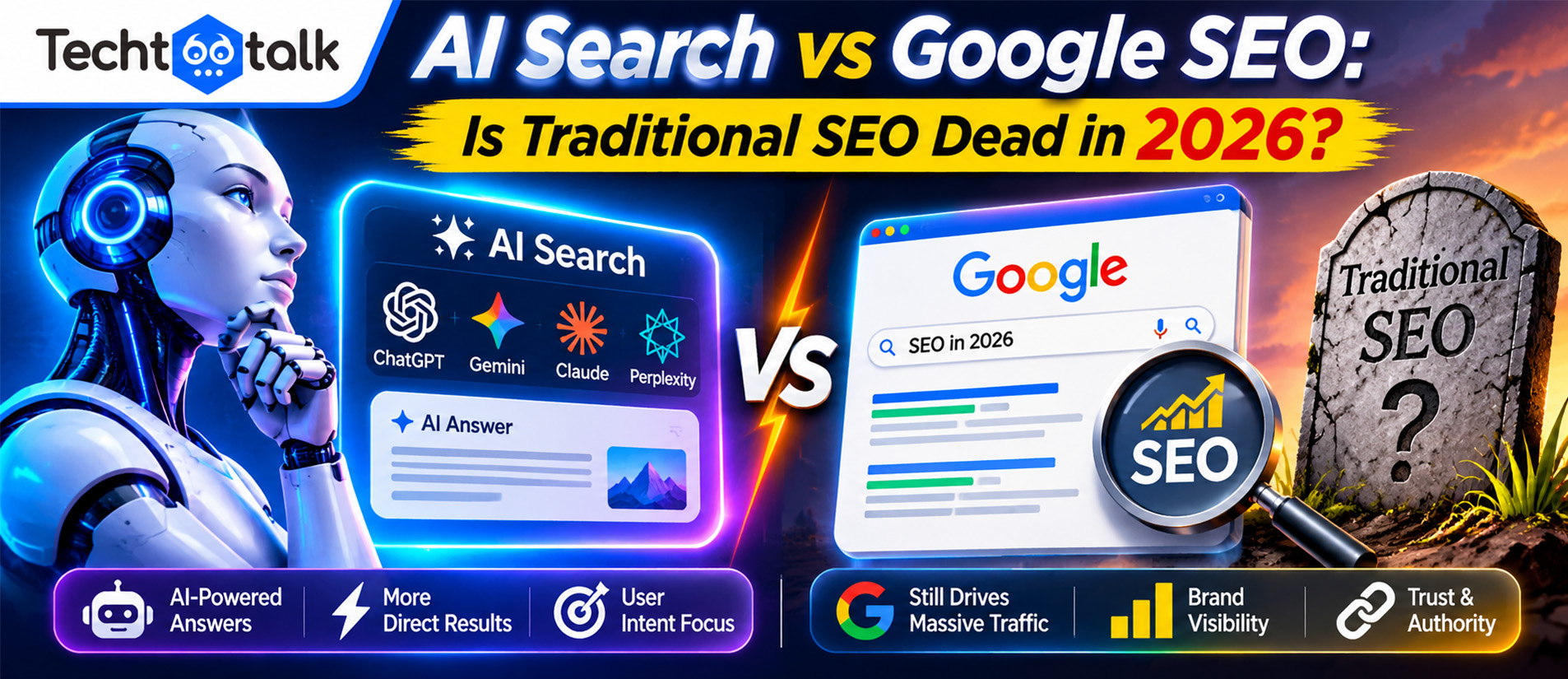
Google AI Overviews now appear at the top of millions of search results. ChatGPT Search, Perplexity, and other AI answer engines are pulling users away from traditional blue-link results. Organic click-through rates are falling. Traffic patterns are shifting in ways that even seasoned SEO professionals have never seen before.
So is traditional SEO actually dead? And if not, what does search look like now, and how do businesses in the USA and UK need to adapt?
The honest answer: SEO is not dead. But the way you do SEO has fundamentally changed. This guide breaks down exactly what died, what thrived, and what you need to do right now.
What Is AI Search?
AI search refers to search engines and answer platforms that use large language models (LLMs) to generate direct, conversational answers rather than simply returning a list of links for the user to click.
The major AI search platforms in 2026 include:
| Platform | Powered By | Key Audience |
|---|---|---|
| Google AI Overviews | Google Gemini | General search users worldwide |
| Google AI Mode | Google Gemini | Power users, researchers |
| ChatGPT Search | OpenAI GPT-5.5 | ChatGPT users, professionals |
| Perplexity AI | Multiple LLMs | Researchers, students |
| Microsoft Copilot | OpenAI + Bing | Business and enterprise users |
| Claude (web search) | Anthropic | Professional users |
Instead of clicking through to a website, users increasingly get their answer directly on the results page. This is the core disruption to traditional SEO.
The Numbers That Tell the Story
The impact of AI search is not theoretical. The data in 2026 is clear and significant:
- Organic click-through rates (CTR) dropped 61% when Google AI Overviews appeared above search results, according to a Seer Interactive study of 25.1 million organic impressions
- AI-powered search could reduce traditional organic CTR by 15 to 25% for informational queries, according to Bain and Company
- On mobile, AI Overviews combined with featured snippets can occupy up to 75.7% of the visible screen, compressing traditional results dramatically
- Google still controlled approximately 89 to 90% of all US and global web traffic as of 2025 to 2026
- The global SEO services market continues to grow at a compound annual growth rate of around 16%
- 91% of marketers reported SEO had a positive impact on their goals in 2024
- AI-referred visitors convert at 4.4x to 23x the rate of traditional organic traffic
The conclusion is not that SEO is dying. It is that the relationship between ranking and traffic has broken apart, and that is a profound shift.
What Died: Old SEO Tactics That No Longer Work
Before looking at what works, here is what AI search has killed or is rapidly burying:
Thin content built purely for keyword targeting. Pages created with keyword density in mind but little real value are now ignored by both Google's AI systems and AI answer engines like Perplexity. If your content does not actually help someone, it will not be cited.
Generic listicles and templated blog posts. The era of churning out "10 Best X Tools" articles with no original insight is over. AI engines can generate that content themselves, so there is no reason to cite yours unless it offers something unique.
Keyword stuffing and link farming. These tactics were already on life support before 2026. AI search has completed the job. Neither AI Overviews nor LLM-based tools care about keyword density or spammy backlink profiles.
Ranking at number one as the finish line. Traditionally, reaching position one on Google meant guaranteed traffic. In 2026, AI Overviews can appear above position one and answer the question without a single click to any website.
Pure traffic as the success metric. Measuring SEO success by page views alone is now dangerously incomplete. A page can be cited by an AI Overview or ChatGPT Search driving brand awareness and conversions without generating a traditional click.
What Still Works: The Living Parts of SEO in 2026
Most of the fundamentals of good SEO still work and are now more important than ever.
Technical SEO. AI search is built on indexed web content. Crawlability, site speed, structured data, Core Web Vitals, and schema markup are the foundation that AI systems rely on to understand and retrieve your content. Without solid technical SEO, your content cannot be cited by AI engines at all.
E-E-A-T (Experience, Expertise, Authoritativeness, Trust). Google's quality signals have never mattered more. AI Overviews and LLMs prioritise content from credible, authoritative sources. Building genuine topical authority in your niche is the single most important long-term SEO investment in 2026.
Topical authority and content depth. AI engines cite sources that demonstrate mastery of a subject. Deep, comprehensive content that answers follow-up questions, addresses nuance, and shows genuine expertise is what gets cited.
Local SEO. AI search has minimal impact on local search intent. If someone in Manchester searches "plumber near me" or someone in Chicago searches "best dentist downtown," they want results near them. Local SEO remains highly valuable and largely protected from AI disruption.
Brand mentions and digital PR. As Ahrefs CMO Tim Soulo noted: brand mentions are the new backlinks for the AI search era. When authoritative sites, journalists, and thought leaders mention your brand, AI systems learn to associate your name with credibility and relevance.
Structured data and schema markup. Content structured clearly with proper headings, FAQ schema, how-to markup, and clear definitions is far more likely to be pulled into AI-generated answers. Schema is no longer optional.
Traditional SEO vs AI SEO (GEO) Side by Side
The new discipline of GEO (Generative Engine Optimisation) sits alongside traditional SEO rather than replacing it.
| Factor | Traditional SEO | AI SEO (GEO) |
|---|---|---|
| Goal | Rank in position 1 to 10 on Google | Be cited in AI-generated answers |
| Success Metric | Organic clicks and traffic | Citation share, brand visibility |
| Key Signals | Backlinks, keywords, technical quality | Authority, depth, E-E-A-T, structure |
| Content Style | Keyword-optimised pages | Authoritative, conversational, cite-worthy |
| Tools | Google Search Console, Ahrefs, SEMrush | AI rank trackers, GEO tools, Perplexity monitoring |
| Click Dependency | High | Low, visibility without clicks |
| Local Search | Highly effective | Less applicable |
| Timeline | 3 to 6 months to see results | 6 to 12 months to build authority |
Which Query Types Are Dying vs Thriving
Not all keywords are equal in the age of AI search.
Most Disrupted, where AI takes the click:
- Simple factual questions such as "What is the capital of France?"
- Definition queries such as "What does ROI mean?"
- Basic how-to searches such as "How do I change a tyre?"
- Surface-level comparison overviews
Least Disrupted, where traditional SEO still wins:
- Local intent queries such as "Best coffee shop in Birmingham"
- Commercial intent such as "Buy running shoes UK"
- Brand-specific queries such as "Nike Air Max 2026 review"
- Deep research requiring high specificity
- News and current events
- Highly specific long-tail queries
What USA and UK Businesses Should Do Right Now
1. Audit Your Content for AI Citability. Review your existing content. Ask: would an AI answer engine confidently cite this as the authoritative source on this topic? If not, improve depth, add expert credentials, and add FAQ sections with structured answers.
2. Invest in Structured Data. Add FAQ schema, HowTo schema, and Article schema to key pages. This directly increases the probability of your content being pulled into AI Overviews and answer engines.
3. Build Topical Authority, Not Just Individual Pages. Create comprehensive topic clusters, a pillar page supported by multiple deep-dive supporting articles. AI engines favour sites that demonstrate mastery across a subject area.
4. Track Citations, Not Just Rankings. Use emerging GEO tools to monitor how often your brand and content appear in AI-generated answers across ChatGPT Search, Perplexity, and Google AI Mode. Citation share is the new rank tracking.
5. Double Down on Local SEO. For UK high street businesses, tradespeople, restaurants, and regional service providers, local SEO remains extremely powerful and AI-resistant. Keep your Google Business Profile optimised and reviews up to date.
6. Prioritise Original Research and Data. AI engines overwhelmingly cite original statistics, surveys, and proprietary data. If your brand produces original research, even a small annual survey, it becomes a highly linkable, citable asset.
7. Blend Traditional SEO with GEO. The winning strategy is not SEO or GEO, it is both. One real-world example: an online lender achieved 178% year-over-year growth in organic-driven loans by blending traditional technical SEO with GEO strategies specifically targeting AI Overviews.
AI Search Demand Is Exploding
Estimated monthly US demand for the query "is SEO dead" on AI assistants rose from approximately 215 searches in January 2026 to over 12,500 by July 2026. The very question people are asking about AI search is itself being asked of AI platforms, a sign of how rapidly user behaviour is shifting.
Semrush projects that AI-driven search experiences could surpass traditional search usage by early 2028, potentially sooner if AI Mode becomes the default Google interface.
Frequently Asked Questions (FAQ)
Q: Is SEO dead because of AI in 2026? No. SEO is evolving, not dying. Google still handles 89 to 90% of global search traffic. AI Overviews are built from indexed web content, meaning technical SEO remains essential. What is dead is thin, keyword-stuffed content that never deserved to rank in the first place.
Q: What is GEO (Generative Engine Optimisation)? GEO is the emerging discipline of optimising content to be cited in AI-generated answers from tools like Google AI Overviews, ChatGPT Search, and Perplexity. It focuses on authority, depth, and content structure rather than keyword rankings alone.
Q: How do I get my content cited in AI Overviews? Focus on E-E-A-T signals, add structured data including FAQ and HowTo schema, write authoritative long-form content, earn brand mentions from credible sites, and build genuine topical expertise over time.
Q: Does AI search affect local SEO? Minimally. Local intent queries are largely AI-resistant because users want nearby, real-world results. Local SEO remains a strong investment for UK and USA businesses with physical locations.
Q: Should UK businesses worry about AI search? Yes and no. UK businesses targeting informational queries should adapt to GEO. UK businesses targeting local or commercial intent queries can largely continue with well-executed traditional SEO, enhanced by better content quality and structured data.
Final Verdict
The death of SEO has been greatly exaggerated, again. But the disruption to how SEO delivers value is real and accelerating.
In 2026, the businesses winning in search are not the ones who abandoned SEO when AI arrived. They are the ones who understood the shift: from ranking to being cited, from traffic to authority, from keywords to trust.
- Old SEO: Rank number one, get the click
- New SEO: Be cited in the answer, build the brand, earn the conversion
The companies that will own search in 2027 and 2028 are optimising for both right now. If you are still running purely traditional SEO playbooks without thinking about GEO and AI citability, your window to adapt is narrowing.
The search landscape has never moved faster. But the fundamentals of being genuinely useful, authoritative, and trustworthy have never been more rewarded.