
Introduction
Search has changed more in the past 18 months than in the previous decade.
In 2026, when someone types a question into Google, they are increasingly met with an AI-generated answer at the top of the page, not a list of blue links. When someone asks ChatGPT a question, it cites sources from across the web. When a researcher uses Perplexity, it synthesises a response from dozens of pages and names the ones it relied on.
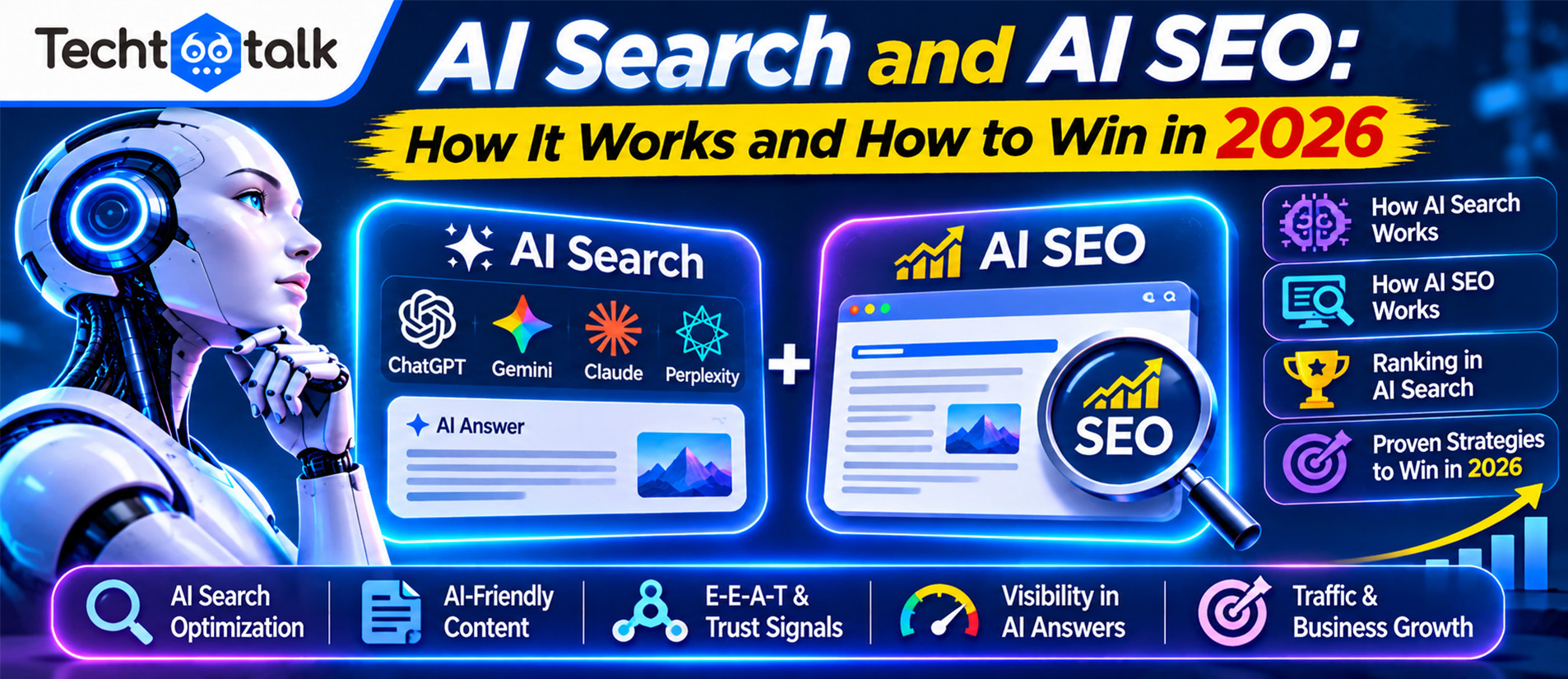
This is AI search — and it has created an entirely new discipline called AI SEO, also known as GEO (Generative Engine Optimization).
If you are a marketer, business owner, blogger, or digital professional in the USA or UK, understanding how AI search works is no longer optional. It is the difference between being found and being invisible.
This guide explains everything: how AI search works under the hood, how traditional SEO and AI SEO differ, and the exact strategies you need to get your content cited by AI engines in 2026.
Part 1: How AI Search Actually Works
The Old Search Pipeline vs the New One
To understand AI SEO, you first need to understand how differently AI search engines process the web compared to traditional Google.
Traditional Google Search Pipeline:
- Crawl — Googlebot visits and reads web pages
- Index — Pages are stored and catalogued in Google's index
- Rank — Pages are scored and ranked using hundreds of signals
- Display — A list of ranked links is shown to the user
- Click — The user clicks a link to visit the page
AI Search Pipeline:
- Crawl / Fetch — The AI system retrieves and reads relevant web content
- Extract — Key facts, claims, and context are pulled from multiple sources
- Synthesise — The AI generates a single, natural-language answer combining insights from many sources
- Cite — The sources used are referenced at the end of the answer
- Display — The user reads the answer directly on the results page, often without clicking anything
The critical shift: in traditional search, the goal is to be ranked. In AI search, the goal is to be cited.
There is no position one in ChatGPT. There is no page one in Perplexity. Visibility in AI search is about how often and how prominently your brand or content is included in synthesised answers.
How AI Engines Decide What to Cite
This is the most important thing to understand about AI SEO. How does an AI search engine like Google AI Overviews, ChatGPT Search, or Perplexity decide which sources to include in its answer?
The process involves two key stages:
Stage 1: Retrieval The AI retrieves relevant content from across the web. For this to work, your content must be:
- Technically accessible (crawlable, indexable, fast-loading)
- Clearly structured (proper headings, schema markup, logical layout)
- Directly relevant to the query being asked
Stage 2: Generation and Citation From the retrieved content, the AI selects sources it deems most trustworthy, accurate, and authoritative to include in its generated answer. For this, your content must be:
- Authoritative and expert (strong E-E-A-T signals)
- Specific and factual (clear claims AI can confidently quote)
- Comprehensive enough to be the definitive answer on the topic
- Corroborated by other sources (the AI prefers content that aligns with the broader consensus of trustworthy sites)
A useful way to think about it: retrieval is technical SEO; citation is content authority. You need both.
The Major AI Search Platforms in 2026
| Platform | How It Works | Key Signal for Citation |
|---|---|---|
| Google AI Overviews | Built on Gemini; appears above organic results for ~47% of US searches | E-E-A-T, structured data, topical authority |
| Google AI Mode | Full conversational interface powered by Gemini | Deep expertise, long-form authority content |
| ChatGPT Search | Real-time web browsing via Bing index; 800M+ weekly users | Bing indexing, brand mentions, authoritative sources |
| Perplexity AI | Retrieves and synthesises from live web sources | Clear factual content, well-structured pages |
| Microsoft Copilot | Powered by OpenAI + Bing; integrated into Windows and Office | Bing indexing, structured data |
| Claude (web search) | Browses the web in real time; used by professionals | Credibility, accuracy, well-cited content |
Part 2: What Is AI SEO (GEO)?
Defining the New Discipline
Generative Engine Optimization (GEO) — also called Answer Engine Optimization (AEO) or AI SEO — is the practice of optimising your content so that AI-powered search engines cite it in their responses.
Google itself, in its official 2026 AI Optimization Guide, stated that AEO and GEO are "still SEO" — meaning GEO builds on top of traditional SEO fundamentals rather than replacing them. SEO fundamentals "support eligibility for AI-generated experiences."
In other words:
- Traditional SEO = rank on page one of Google
- GEO (AI SEO) = be part of the answer itself
Regular LLM optimization makes content AI-readable. GEO makes content AI-quotable.
Traditional SEO vs AI SEO (GEO) vs AEO: The Full Picture
| Dimension | Traditional SEO | GEO (Generative Engine Optimization) | AEO (Answer Engine Optimization) |
|---|---|---|---|
| Goal | Rank in search results | Be cited in AI-generated answers | Directly answer specific questions |
| Success Metric | Rankings and organic clicks | Citation frequency and brand visibility | Featured snippet and voice answer inclusion |
| Key Signal | Backlinks, keywords, technical quality | Authority, depth, E-E-A-T, brand mentions | Direct question-answer format, FAQ schema |
| Content Style | Keyword-optimised pages | Authoritative, citation-worthy, comprehensive | Concise, direct Q and A format |
| Platforms | Google, Bing | ChatGPT, Perplexity, Google AI Mode | Google AI Overviews, voice assistants |
| Click Dependency | High | Low | Very low |
| Works Without | Nothing | Traditional SEO as foundation | GEO content depth |
All three work together. The best performing content in 2026 is optimised for all three simultaneously.
Part 3: The Numbers That Make AI SEO Urgent
The case for AI SEO is not theoretical. Here is the data:
- Google AI Overviews appear in roughly 47 to 50% of all US searches in 2026
- Nearly 60% of Google searches end without a click — zero-click search is now the norm
- ChatGPT has over 800 million weekly active users, making it the second most used search interface after Google
- Brand mentions correlate 0.664 with AI Overview appearances — meaning the more other authoritative sites mention your brand, the more likely you are to be cited
- Content optimised for GEO sees a 30 to 40% increase in AI search visibility
- 86% of SEO professionals have now integrated AI into their SEO workflows
- Demand for the search query "agentic SEO" grew by 5,867% in 2026 alone
Part 4: The Complete AI SEO Strategy for 2026
Step 1: Make Sure AI Crawlers Can Access Your Content
Before any other optimisation, your content must be technically accessible to AI crawlers. This means:
- Allow AI bot crawling in your robots.txt file. Some sites accidentally block AI crawlers (like Googlebot-Extended, ChatGPT-User, PerplexityBot) while only intending to block scraping bots. Check your robots.txt carefully.
- Ensure fast load times. AI retrieval systems favour pages that load quickly and cleanly.
- Use clean, readable HTML. Avoid heavy JavaScript rendering for key content — AI crawlers may not execute JavaScript the same way browsers do.
- Submit updated sitemaps to Google Search Console and Bing Webmaster Tools regularly.
Step 2: Build Strong E-E-A-T Signals
E-E-A-T stands for Experience, Expertise, Authoritativeness, and Trustworthiness. It is the single most important quality framework for both traditional SEO and AI SEO in 2026.
AI engines are trained to favour sources that demonstrate real-world expertise and credibility. Here is how to build E-E-A-T:
- Author credentials: Add detailed author bios with qualifications, experience, and professional profiles linked to LinkedIn
- About page: A thorough, credible About page helps AI systems understand who is behind the content
- Original research: Publish your own surveys, data, or case studies. Original data is one of the most citable assets you can create.
- Expert quotes: Include quotes from named experts in your field. AI engines weight content that cites real people with real credentials.
- External mentions: Earn coverage and brand mentions in reputable publications in the USA and UK (trade press, national media, industry bodies)
Step 3: Optimise for Topical Authority, Not Individual Keywords
In traditional SEO, you optimised individual pages for individual keywords. In AI SEO, the focus shifts to topical authority — demonstrating that your website is the most comprehensive, credible resource on a given subject.
AI engines prefer to cite sources that have deep coverage of a topic, not sources that wrote one good post about it once.
How to build topical authority:
- Create a pillar page (the definitive, comprehensive guide on a topic)
- Support it with cluster articles that go deep on specific subtopics
- Interlink the cluster tightly so AI crawlers understand the thematic relationship
- Update content regularly — freshness is a positive signal for AI retrieval
Example structure for a topic cluster on AI Tools:
- Pillar: Best AI Tools for Business 2026 (comprehensive overview)
- Cluster: Best AI Writing Tools, Best AI Coding Tools, AI Tools for HR, AI Tools for Finance, etc.
Step 4: Structure Content for AI Extractability
AI engines extract specific sentences, facts, and answers from your pages. If your content is structured clearly, AI can extract and cite it confidently. If it is a wall of text with no clear structure, AI skips it.
Structural best practices for AI SEO:
- Use clear H2 and H3 headings that directly state what each section answers
- Write direct, declarative sentences that AI can lift as standalone quotes (e.g. "Business process automation can save businesses 20 to 35% on operating costs according to X" is citable; vague prose is not)
- Use FAQ sections at the end of every article — these are prime real estate for AI Overview citations
- Use definition boxes or TL;DR summaries at the top of articles — AI frequently pulls these
- Use numbered lists and bullet points for step-by-step processes — AI engines love structured, scannable content
- Use tables for comparisons — AI retrieval systems extract tabular data well
Step 5: Add Structured Data (Schema Markup)
Schema markup is code you add to your pages that explicitly tells search engines and AI systems what your content is about. In 2026, it is one of the clearest signals you can send to AI engines.
Priority schema types for AI SEO:
- FAQPage schema — Signals that your content directly answers common questions
- Article schema — Establishes content type, author, publish date, and topic
- HowTo schema — For step-by-step guides; frequently cited in AI Overviews
- Organization schema — Establishes your brand identity and credibility
- Person schema — Links authors to their credentials and profiles
- BreadcrumbList schema — Helps AI understand your site structure
Step 6: Earn Brand Mentions Across the Web
One of the most powerful signals in AI SEO is brand mention frequency. Research shows brand mentions correlate 0.664 with AI Overview appearances — a very strong relationship.
AI engines learn which brands are trusted authorities by analysing how often credible sources mention them. This is why digital PR has become one of the most important SEO investments of 2026.
How to earn brand mentions:
- Publish original research or data that journalists will cite
- Contribute expert commentary to industry publications in the USA and UK
- Build a consistent presence on platforms AI engines monitor (LinkedIn, industry forums, niche publications)
- Pursue podcast appearances, webinars, and conference speaking opportunities
- Sponsor or partner with credible organisations in your sector
As Ahrefs CMO Tim Soulo summarised: brand mentions are the new backlinks for the AI search era.
Step 7: Track AI Search Visibility, Not Just Rankings
One of the biggest mistakes in 2026 is measuring AI SEO performance with traditional rank-tracking tools. If your content is being cited in ChatGPT or Perplexity, a standard rank tracker will not show it.
What to measure in AI SEO:
- Citation frequency: How often does your brand appear in AI-generated answers across ChatGPT, Perplexity, and Google AI Mode?
- Brand mention share: Relative to competitors, how often is your brand named?
- AI Overview inclusion rate: For which of your target queries does Google show an AI Overview that includes your content?
- Zero-click impression share: Even without clicks, your content may be driving brand awareness
Tools for tracking AI search visibility in 2026:
- Semrush AI Toolkit
- Ahrefs AI search tracking features
- Profound (AI citation monitoring)
- Scrunch (brand visibility in AI)
- Google Search Console AI Performance Report (new in 2026)
Part 5: AI SEO Quick Wins You Can Do This Week
Not every AI SEO improvement takes months. Here are actions that can improve your AI search visibility quickly:
- Add an FAQ section to your 10 most important pages — with clear, direct question-and-answer format and FAQPage schema
- Check your robots.txt — make sure you are not accidentally blocking AI crawlers
- Add or improve author bios — full credentials, photo, and links to professional profiles
- Write a TL;DR or key takeaway box at the top of long articles
- Submit your sitemap to both Google Search Console and Bing Webmaster Tools
- Add Organisation and Article schema to your homepage and key content pages
- Search for your brand name in ChatGPT and Perplexity — see how (or whether) you appear, and note which competitors do
Traditional SEO Still Matters: The Foundation Layer
It is essential to understand that GEO does not replace traditional SEO. It builds on top of it.
AI search engines retrieve content from the web. If your content is not indexed, not crawlable, not technically sound, and not ranking at all in traditional search, it will not appear in AI search either. As one expert put it: SEO is the foundation layer that AI search is built on. Killing SEO would be like tearing out the foundation of a building and expecting the upper floors to float.
The winning strategy in 2026 combines:
- Technical SEO as the foundation (crawlability, speed, indexing)
- Traditional on-page SEO as the structure (keywords, headings, internal linking)
- GEO and E-E-A-T as the authority layer (depth, credibility, citation-worthiness)
- Digital PR and brand mentions as the trust layer (external validation)
Frequently Asked Questions (FAQ)
Q: What is the difference between SEO and GEO? Traditional SEO optimises content to rank in search result lists. GEO (Generative Engine Optimization) optimises content to be cited inside AI-generated answers from platforms like ChatGPT, Perplexity, and Google AI Overviews. GEO builds on SEO fundamentals and extends them.
Q: Does Google still matter for AI SEO? Absolutely. Google still handles the vast majority of global search traffic, and its AI Overviews appear in roughly half of US searches. Google itself says GEO is "still SEO" — the same quality signals that rank well in Google also support eligibility for AI-generated features.
Q: How do I get cited in ChatGPT Search? ChatGPT Search uses the Bing index. Ensure your site is indexed in Bing Webmaster Tools, build strong E-E-A-T signals, earn brand mentions from credible sources, and structure your content with clear headings and direct factual statements that AI can confidently extract.
Q: How long does AI SEO take to work? Some improvements, like adding FAQ schema or improving page structure, can show results within weeks. Building topical authority and earning brand mentions is a 6 to 12 month investment. The best results come from consistent, long-term content and PR strategy.
Q: Is AI SEO relevant for UK businesses? Yes. Google AI Overviews, ChatGPT Search, and Perplexity are all widely used in the UK. The same GEO strategies apply globally, with one addition: UK businesses should ensure their content addresses UK-specific audiences, regulations, and contexts where relevant, as this increases relevance and citation likelihood for UK-language queries.
Final Verdict
AI search is not the future of search. It is the present.
In 2026, the businesses winning in search understand that the game has two boards: the traditional board where you compete to rank, and the new board where you compete to be cited. The first board still matters enormously. The second board is where the fastest growth opportunities now live.
The good news: the fundamentals have not changed. Create content that is genuinely expert, clearly structured, and authoritatively presented. Make it technically accessible. Build your brand's credibility across the web. The platforms change. These principles do not.
The question is not whether AI search will affect your visibility. It already is. The question is whether you are optimising for it.
AI SEO Action Plan Checklist
Technical Foundation:
- Verify AI crawlers are not blocked in robots.txt
- Submit sitemap to Google Search Console and Bing Webmaster Tools
- Improve page load speed (target under 2 seconds)
- Implement Organisation, Article, and FAQPage schema
Content Authority:
- Add detailed author bios with credentials to all key pages
- Create or refresh pillar pages for your top 3 to 5 topic areas
- Build supporting cluster articles around each pillar
- Add FAQ sections with direct question-and-answer format to all major pages
- Write TL;DR summaries at the top of long-form articles
Brand Visibility:
- Monitor brand mentions in ChatGPT, Perplexity, and Google AI Mode weekly
- Publish original research or proprietary data at least twice per year
- Pursue digital PR placements in USA or UK industry publications
- Build LinkedIn thought leadership to increase expert mention frequency
Tracking:
- Set up AI citation tracking via Semrush, Ahrefs, or Profound
- Monitor Google Search Console for AI Overview performance data
- Track citation share relative to top 3 competitors monthly