

Mark Zuckerberg Biography: The Visionary Who Built Facebook and Leads Meta into the AI Era
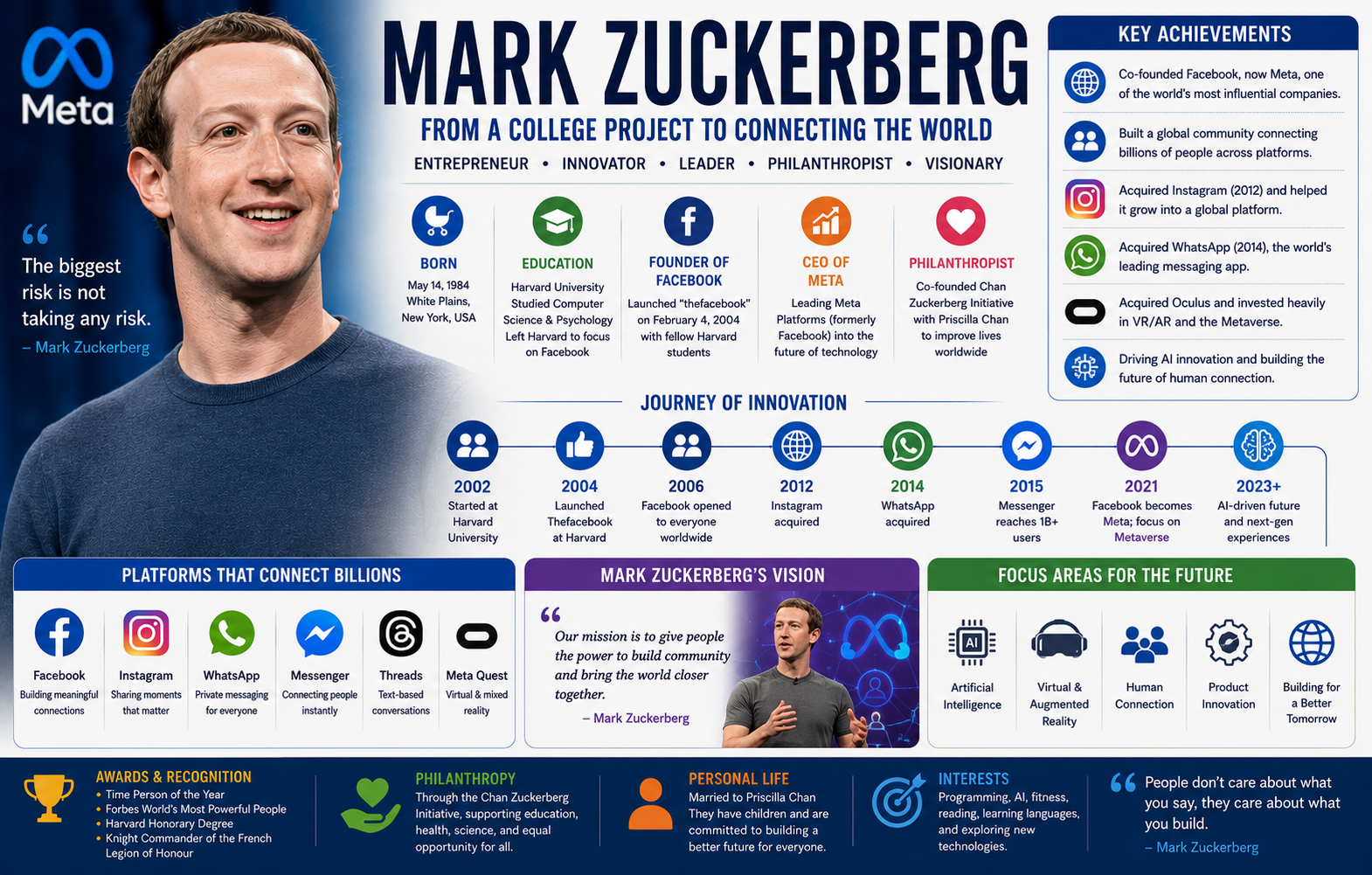
Mark Zuckerberg is one of the world's most influential entrepreneurs and technology leaders. As the co-founder, Chairman, and Chief Executive Officer (CEO) of Meta Platforms, formerly Facebook, he transformed social networking and digital communication. What began as a college project grew into a global technology company connecting billions of people through platforms such as Facebook, Instagram, WhatsApp, Messenger, and Threads.
In recent years, Zuckerberg has expanded Meta's focus beyond social media into Artificial Intelligence (AI), virtual reality (VR), augmented reality (AR), and the metaverse, making him one of the key figures shaping the future of technology.
Today, Mark Zuckerberg is recognized as one of Silicon Valley's most successful entrepreneurs, inspiring millions of developers, business leaders, and startup founders across the United States, the United Kingdom, India, and around the world.
Early Life
Mark Elliot Zuckerberg was born on May 14, 1984, in White Plains, New York, USA.
He grew up in Dobbs Ferry, New York, where his father, Edward Zuckerberg, worked as a dentist, and his mother, Karen Zuckerberg, was a psychiatrist.
From a young age, Mark showed exceptional talent in computers and programming. His father introduced him to computers early, and by the age of 12, Mark had already created a messaging program called ZuckNet, which allowed communication between his family's home and his father's dental office.
His passion for software development continued to grow throughout his teenage years.
Education
Mark Zuckerberg attended Phillips Exeter Academy, one of the top private schools in the United States.
He excelled in mathematics, science, literature, and computer programming. During high school, he built several software applications and games, attracting attention for his programming skills.
In 2002, Zuckerberg enrolled at Harvard University, where he studied computer science and psychology.
While at Harvard, he developed several online projects before creating the platform that would eventually become Facebook.
Although he left Harvard before completing his degree, he later received an honorary doctorate for his contributions to technology and society.
The Birth of Facebook
In February 2004, Mark Zuckerberg launched Facebook from his Harvard University dorm room with fellow students:
- Eduardo Saverin
- Andrew McCollum
- Dustin Moskovitz
- Chris Hughes
Initially, Facebook was designed exclusively for Harvard students.
Its popularity spread rapidly to other universities and eventually to users worldwide.
The platform introduced a new way for people to:
- Connect with friends
- Share photos
- Communicate online
- Build communities
- Discover news and events
Within a few years, Facebook became the largest social networking platform in the world.
Building a Global Technology Company
Under Mark Zuckerberg's leadership, Facebook expanded far beyond a social networking website.
Major milestones include:
Instagram Acquisition
In 2012, Facebook acquired Instagram, which has since become one of the world's most popular photo and video sharing platforms.
WhatsApp Acquisition
In 2014, Facebook acquired WhatsApp, connecting billions of users through secure messaging and voice communication.
Messenger
Facebook Messenger evolved into one of the world's largest messaging applications.
Oculus VR
Meta acquired Oculus, enabling major investments in virtual reality technology.
Threads
Meta launched Threads as a text-based social platform connected to Instagram.
These acquisitions helped Meta become one of the largest technology companies globally.
Becoming Meta
In 2021, Facebook officially changed its corporate name to Meta Platforms, Inc.
The rebranding reflected Zuckerberg's vision of building the Metaverse, a digital environment where people can work, learn, socialize, and collaborate using immersive virtual and augmented reality technologies.
Meta continues investing billions of dollars in:
- Virtual Reality (VR)
- Augmented Reality (AR)
- AI-powered experiences
- Smart glasses
- Mixed Reality
- Next-generation computing
Leading the AI Revolution
Artificial Intelligence has become one of Mark Zuckerberg's highest priorities.
Under his leadership, Meta has developed advanced AI technologies for:
- AI Assistants
- Large Language Models (LLMs)
- Content Recommendation
- Image Generation
- Video Understanding
- Business Automation
- AI-powered Advertising
Meta's open-source AI models have contributed significantly to the global AI ecosystem, helping developers and businesses build innovative AI applications.
Leadership Style
Mark Zuckerberg is known for his engineering-focused and product-driven leadership.
His leadership principles include:
- Move fast and innovate.
- Build products that connect people.
- Learn continuously.
- Think long-term.
- Take calculated risks.
- Invest in future technologies.
- Empower engineering teams.
His willingness to invest in ambitious technologies has enabled Meta to remain one of the world's leading technology companies.
Challenges and Controversies
Throughout his career, Mark Zuckerberg has faced significant challenges, including:
- Privacy concerns
- Data security issues
- Misinformation on social platforms
- Regulatory investigations
- Competition from emerging social media platforms
Despite these challenges, he has continued to invest heavily in improving Meta's products, security, AI capabilities, and long-term innovation.
Philanthropy
In 2015, Mark Zuckerberg and his wife Priscilla Chan launched the Chan Zuckerberg Initiative (CZI).
The organization focuses on:
- Education
- Scientific research
- Disease prevention
- Equal opportunity
- Artificial Intelligence
- Community development
The initiative supports projects designed to improve health, education, and technology for future generations.
Awards and Recognition
Mark Zuckerberg has received numerous honors throughout his career.
Some of his notable recognitions include:
- Time Magazine Person of the Year
- Forbes World's Most Powerful People
- Fortune Businessperson Recognition
- Harvard Honorary Degree
- Technology Leadership Awards
He is consistently recognized as one of the world's most influential technology entrepreneurs.
Personal Life
Mark Zuckerberg is married to Priscilla Chan, a physician and philanthropist.
The couple has children and is actively involved in charitable initiatives through the Chan Zuckerberg Initiative.
Outside of work, Zuckerberg enjoys:
- Programming
- Artificial Intelligence
- Fitness
- Brazilian Jiu-Jitsu
- Reading
- Technology research
He is known for maintaining a disciplined daily routine and a strong focus on continuous learning.
Life Lessons from Mark Zuckerberg
Mark Zuckerberg's journey offers valuable lessons for entrepreneurs and students.
Start Early
Many successful companies begin as small ideas.
Solve Real Problems
Facebook succeeded because it addressed a genuine need for online communication.
Keep Improving
Successful products evolve continuously.
Think Long-Term
Building transformational companies requires patience and vision.
Embrace Innovation
The future belongs to businesses willing to invest in emerging technologies.
Famous Quotes
Some of Mark Zuckerberg's most inspiring quotes include:
"The biggest risk is not taking any risk."
"Move fast and build things."
"People don't care about what you say, they care about what you build."
"The question isn't, 'What do we want to know about people?' It's, 'What do people want to tell about themselves?'"
Legacy
Mark Zuckerberg has fundamentally changed how people communicate, share information, and build online communities.
Through Facebook, Instagram, WhatsApp, Messenger, and Meta's AI initiatives, he has connected billions of people worldwide and influenced the future of digital communication.
His investments in artificial intelligence, virtual reality, and the metaverse continue to shape the next generation of computing technologies.
As one of the youngest self-made technology billionaires in history, Zuckerberg's journey demonstrates how a simple idea developed in a college dorm room can evolve into a company that impacts billions of lives.
Conclusion
Mark Zuckerberg's biography is a remarkable story of innovation, ambition, and entrepreneurial success. From creating Facebook as a university networking platform to leading Meta's advancements in artificial intelligence and immersive technologies, he has continually pushed the boundaries of what technology can achieve.
His vision has transformed social media, digital communication, and the future of AI. For entrepreneurs, students, developers, and technology enthusiasts, Mark Zuckerberg's journey is a powerful reminder that bold ideas, continuous innovation, and long-term thinking can create products that change the world.