
Gemini 3.5 Pro Delayed a Third Time — And Google May Ship a Stopgap Instead
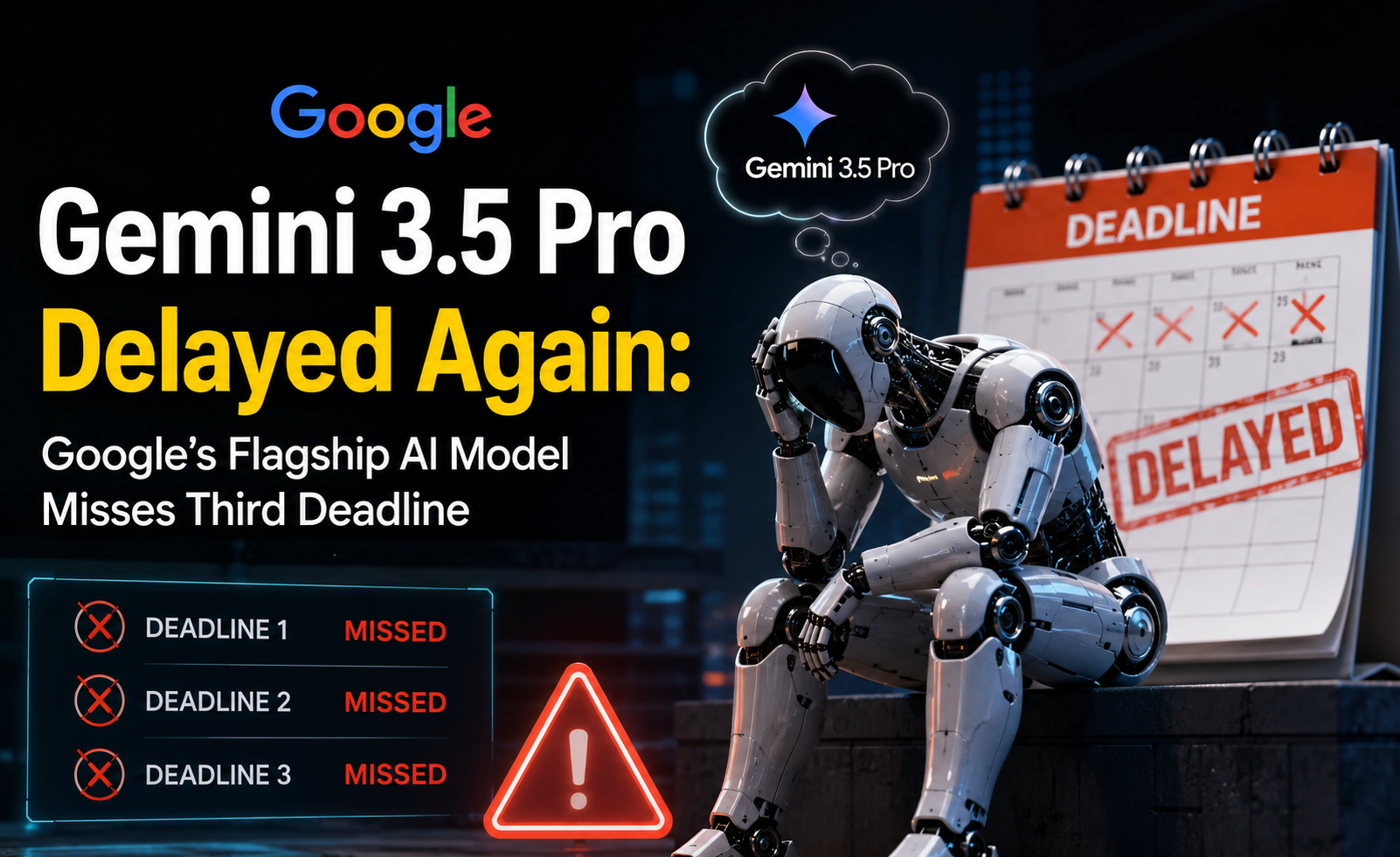
Google's most important AI release of the year is still not out the door. Gemini 3.5 Pro, the company's flagship large language model, has reportedly missed its internal target for a third consecutive time — and this latest slip is doing real damage, both to Google's competitive position and to Alphabet's stock price.
For a company that has spent years positioning itself as the deepest AI research lab in the world, a repeated delay on its flagship model is more than an embarrassment. It's a signal that Google's AI division is under real pressure at exactly the moment rivals are moving fast.
What Happened
Gemini 3.5 Pro was expected to launch around July 17, 2026. That date has now come and gone without an official release, making it the third missed target for the model this year. Google has not published a model card, pricing, or benchmark results, so there's no official confirmation of what's holding the release back — only industry reporting that testing has repeatedly fallen short of the bar Google set for itself, particularly on coding and complex reasoning tasks.
According to industry reports, Google scrapped an earlier base model back in June and restarted parts of the pretraining process — a costly and time-consuming decision that suggests the issues go deeper than routine polish or safety review. Restarting pretraining on a frontier-scale model isn't something labs do lightly; it typically points to the model falling meaningfully short of internal quality targets rather than needing minor fixes.
In response to the slipping timeline, Google is reportedly weighing a stopgap release: a lighter "Gemini 3.6 Flash" model that could ship sooner, buying time while engineers continue working on the full Pro version behind the scenes.
Why a Third Delay Is Different From the First
One missed deadline can usually be chalked up to normal engineering caution — AI labs routinely push back release dates to fix safety issues, improve benchmarks, or polish user experience before a public launch. That's normal, even healthy, product discipline.
But a third slip changes the story. It suggests something more structural is going on, whether that's a training run that didn't hit expectations, an evaluation bar Google isn't willing to lower, internal disagreement about readiness, or some combination of all three. Repeated delays also tend to compound reputational damage in a way a single delay doesn't — each additional slip makes the next one look less like caution and more like a pattern.
The idea of releasing a "Flash" (lighter, faster, cheaper) model to fill the gap left by a delayed "Pro" (flagship, most capable) model is also worth unpacking. On one hand, it would give Google something new to announce, keep developer attention on the Gemini brand, and generate positive headlines while the real flagship model finishes baking. On the other hand, it's a tacit admission that the top-tier model enterprise customers have been waiting for isn't close to ready — shipping a mid-tier model to cover for a missing flagship is a workaround, not a solution.
Market Reaction: Alphabet Shares Drop
The financial market didn't shrug this off. Alphabet's stock fell roughly 4% following the delay reports — a meaningful move for a company of Alphabet's size, where a few percentage points translate into tens of billions of dollars in market value. It's also a sign that investors have started treating AI model execution as a material factor in how they value Alphabet, not just a research side project.
Stock reactions like this matter beyond the trading floor. They shape how much operating pressure Google's leadership feels to ship something — anything — in the near term, and they influence how enterprise customers and cloud partners perceive Google's AI trajectory when deciding where to place their own bets.
Why This Matters for the Broader AI Race
The timing is especially costly for Google. Enterprises currently evaluating frontier AI models are actively choosing between several strong competitors right now, not waiting indefinitely. Every week that Gemini's flagship model is absent from that conversation is a week those contracts get signed with someone else instead — and enterprise AI contracts, once signed, tend to stick around for a while due to switching costs and integration work.
The delay also lands at a particularly inconvenient moment. Open-weight models from Chinese AI labs have recently drawn unusual attention for their coding and reasoning performance, with at least one topping a major coding leaderboard and preparing to release its weights for free. That combination — a competitor's model outperforming expectations on benchmarks, and doing so for free — adds real pressure on Google to ship something credible soon, both to reassure enterprise customers and to keep developer mindshare from drifting elsewhere.
To be fair, Google hasn't gone quiet during this stretch. The company has continued shipping other AI-related products, including updates to its Search AI features and its notebook and research tools, some of which have reportedly reached tens of millions of users. But none of those carry the weight of a flagship model launch, and they haven't been enough to offset the narrative created by a third consecutive delay.
The Bigger Picture: Is This a Google Problem or an Industry Problem?
It's worth asking whether this is uniquely a Google issue or part of a broader pattern across the AI industry in 2026. Frontier model development has gotten more expensive, more compute-intensive, and arguably harder to predict as labs push against the limits of what more scale alone can deliver. Delays and scrapped training runs aren't unheard of industry-wide — but Google's position as one of the best-funded, best-resourced AI labs in the world makes repeated delays stand out more than they might for a smaller competitor.
There's also a distribution angle that's easy to overlook. Google doesn't just need Gemini 3.5 Pro to be a good model — it needs it to justify Gemini's placement across Android, Search, Workspace, and Google Cloud, where the company has enormous built-in distribution advantages that competitors don't have. A delayed flagship model doesn't erase those advantages, but it does raise the stakes on making sure the eventual release lives up to expectations.
What to Watch Next
- Whether Google ships the rumored "Gemini 3.6 Flash" as a stopgap, or holds out for the full Pro release
- Whether Google eventually publishes an official model card, pricing, and benchmark results
- How enterprise customers and developers respond if the delay stretches further into Q3 2026
- Whether Alphabet's stock continues to react to AI-related news in the coming weeks
- How Gemini 3.5 Pro, whenever it arrives, actually compares to competing frontier models on real-world coding and reasoning tasks — not just benchmark claims
Frequently Asked Questions
Why is Gemini 3.5 Pro delayed? Gemini 3.5 Pro reportedly missed its July 17, 2026 target for the third time after falling short on coding and complex reasoning benchmarks during testing. Reports indicate Google scrapped an earlier base model in June and restarted parts of pretraining, suggesting the issues run deeper than routine pre-launch polish.
What is Gemini 3.6 Flash? Gemini 3.6 Flash is a reportedly rumored, lighter-weight stopgap model Google is considering releasing while the full Gemini 3.5 Pro model continues development. Google has not officially confirmed this release.
How did the stock market react to the delay? Alphabet shares fell approximately 4% following reports of the third delay, reflecting investor concern about Google's AI execution and competitive position.
Has Google confirmed any details about Gemini 3.5 Pro? As of this writing, Google has not published an official model card, pricing, or benchmark results for Gemini 3.5 Pro, so all details about its performance and release timeline are based on industry reporting rather than official confirmation.
For now, Gemini 3.5 Pro remains one of the most closely watched "not yet released" AI models in the industry — and its fate says a lot about how competitive the AI model race has become in 2026.