

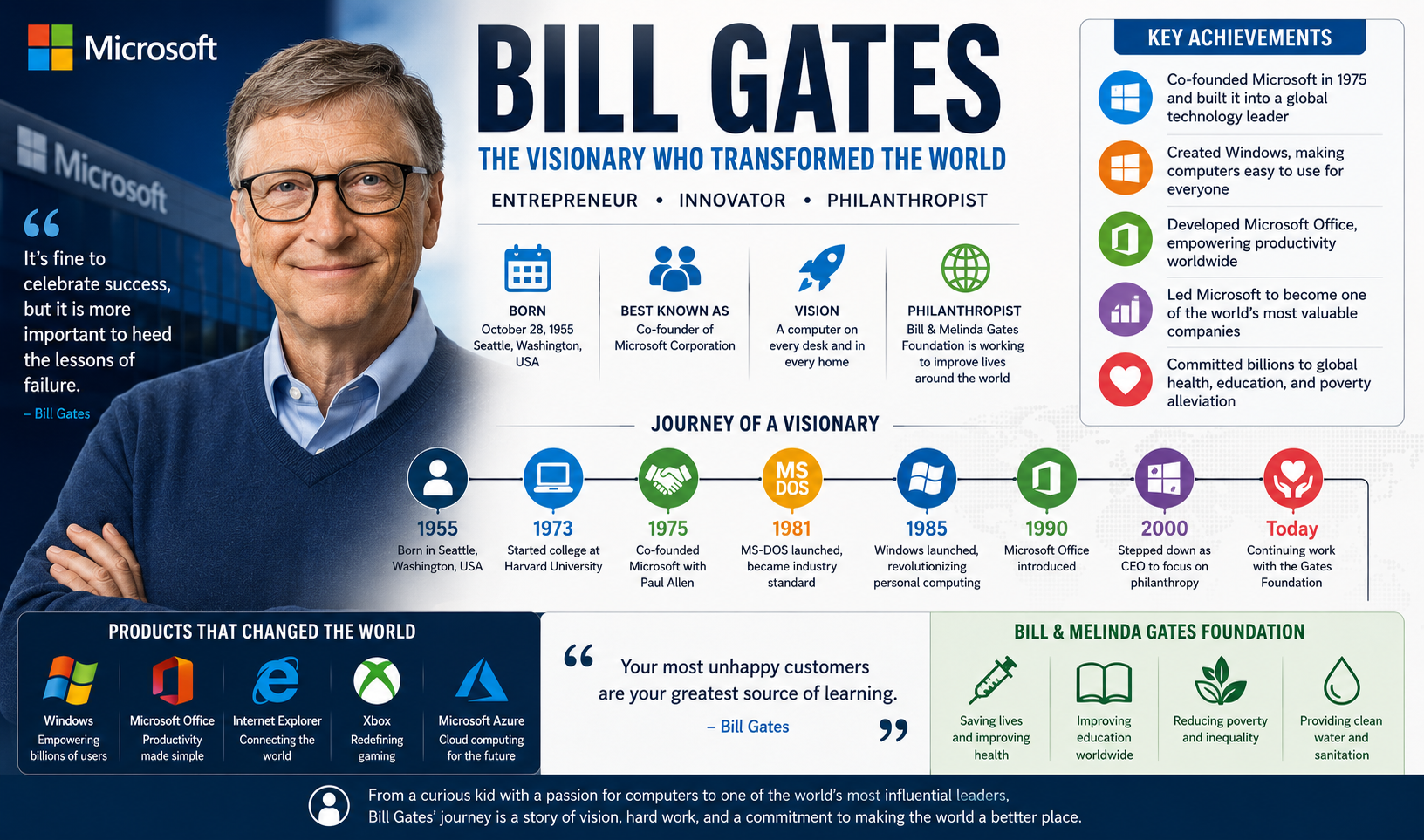
Bill Gates Biography: The Visionary Who Revolutionized Personal Computing
Bill Gates is one of the most influential entrepreneurs, software pioneers, and philanthropists in modern history. As the co-founder of Microsoft Corporation, he played a major role in making personal computers accessible to millions of people around the world. His vision transformed Microsoft into one of the world's largest technology companies and helped shape the modern digital age.
Beyond business, Bill Gates is widely respected for his philanthropic efforts through the Bill & Melinda Gates Foundation, where he has dedicated billions of dollars to improving global health, education, and poverty reduction. His remarkable journey from a curious young programmer to one of the world's most successful business leaders continues to inspire entrepreneurs, students, and innovators across the United States, the United Kingdom, India, and many other countries.
Early Life
Bill Gates was born as William Henry Gates III on October 28, 1955, in Seattle, Washington, USA. He grew up in a supportive family that encouraged curiosity, learning, and academic excellence.
From a young age, Gates showed exceptional intelligence and a strong interest in mathematics and problem-solving. His parents noticed his passion for learning and enrolled him at Lakeside School, where he first encountered a computer terminal. At a time when computers were rare and expensive, this opportunity changed the course of his life.
Bill spent countless hours learning programming languages and writing software. His fascination with computers quickly turned into an ambition to build software that could make computers useful for everyone.
Education
Bill Gates attended Lakeside School, where he developed his programming skills alongside his close friend Paul Allen. Together, they experimented with computer software and even created programs for local businesses.
In 1973, Gates enrolled at Harvard University to study mathematics and computer science. Although he excelled academically, he believed that the emerging personal computer industry offered a once-in-a-lifetime opportunity.
After two years at Harvard, Gates made the bold decision to leave college and focus entirely on building Microsoft with Paul Allen.
His decision would become one of the most famous examples of entrepreneurial risk-taking in history.
Founding Microsoft
In 1975, Bill Gates and Paul Allen founded Microsoft with the goal of developing software for the rapidly growing personal computer market.
Their first major breakthrough came when they created a version of the BASIC programming language for the Altair 8800, one of the earliest personal computers.
As more computer manufacturers entered the market, Microsoft expanded rapidly by developing operating systems and software applications.
The company's biggest breakthrough came when Microsoft signed a contract to provide the operating system for IBM's personal computers.
Microsoft developed MS-DOS, which soon became the standard operating system for millions of computers worldwide.
The Windows Revolution
In 1985, Microsoft introduced Windows, a graphical operating system that made computers easier for everyday users.
Unlike command-line systems, Windows allowed people to interact with computers using icons, menus, and a mouse.
Over the following decades, Windows became the world's most widely used operating system.
Popular versions such as:
- Windows 95
- Windows XP
- Windows 7
- Windows 10
- Windows 11
helped Microsoft dominate the global software market.
Windows revolutionized personal computing by making technology accessible to businesses, schools, and households around the world.
Microsoft Office
Another major achievement under Bill Gates' leadership was the development of Microsoft Office.
The software suite includes:
- Microsoft Word
- Microsoft Excel
- Microsoft PowerPoint
- Microsoft Outlook
These applications became essential tools for businesses, educational institutions, and governments worldwide.
Today, Microsoft Office remains one of the most widely used productivity software suites in the world.
Leadership Style
Bill Gates is known for his analytical thinking, attention to detail, and relentless focus on innovation.
His leadership philosophy includes:
- Solve real-world problems with technology.
- Continuously learn and improve.
- Hire talented people.
- Encourage innovation.
- Focus on long-term growth.
- Make software simple and useful.
He believed that software would become the foundation of the future digital economy—a prediction that proved remarkably accurate.
Stepping Down from Microsoft
In 2000, Bill Gates stepped down as Microsoft's CEO, although he continued serving as Chairman and Chief Software Architect for several years.
He gradually shifted his focus toward philanthropy while remaining involved in Microsoft's long-term strategy.
Today, Microsoft continues to be one of the world's most valuable technology companies, producing software, cloud computing services, artificial intelligence solutions, gaming platforms, and business applications.
Philanthropy
One of Bill Gates' greatest contributions extends beyond technology.
In 2000, Bill and Melinda Gates established the Bill & Melinda Gates Foundation, one of the largest charitable foundations in the world.
The foundation focuses on:
- Global health
- Disease prevention
- Vaccine development
- Education
- Poverty reduction
- Agricultural innovation
- Clean sanitation
The foundation has invested billions of dollars in projects aimed at improving the lives of people in developing countries.
Bill Gates has also encouraged other billionaires to donate a significant portion of their wealth through initiatives such as The Giving Pledge.
Awards and Recognition
Bill Gates has received numerous international awards for his contributions to technology and philanthropy.
Some of his notable recognitions include:
- Presidential Medal of Freedom
- Padma Bhushan (India)
- Time Magazine's 100 Most Influential People
- Knight Commander of the Order of the British Empire (Honorary)
- Forbes World's Most Powerful People
These honors recognize both his technological achievements and his humanitarian efforts.
Life Lessons from Bill Gates
Bill Gates' career offers valuable lessons for entrepreneurs and students.
Never Stop Learning
Gates is known for reading dozens of books every year and continuously expanding his knowledge.
Think Long-Term
Rather than chasing short-term profits, Gates focused on building products that would remain useful for decades.
Solve Big Problems
He believed that technology should simplify people's lives and improve productivity.
Build Strong Partnerships
Microsoft's success was built on strategic collaborations with hardware manufacturers and software developers.
Give Back to Society
Through philanthropy, Gates has demonstrated that business success can also create positive social impact.
Famous Quotes
Some of Bill Gates' most inspiring quotes include:
"Success is a lousy teacher. It seduces smart people into thinking they can't lose."
"Your most unhappy customers are your greatest source of learning."
"Don't compare yourself with anyone in this world. If you do so, you are insulting yourself."
"It's fine to celebrate success, but it is more important to heed the lessons of failure."
Legacy
Bill Gates' influence extends far beyond Microsoft.
His work helped launch the personal computer revolution, transforming how people work, learn, communicate, and conduct business. Microsoft software became the backbone of offices, schools, and homes across the globe.
In addition to his technological achievements, Gates' philanthropic work has improved healthcare, education, and quality of life for millions of people worldwide.
Today, he remains a respected voice on technology, innovation, artificial intelligence, climate change, and global development.
Conclusion
Bill Gates' journey from a young computer enthusiast in Seattle to the co-founder of one of the world's largest technology companies is one of the greatest success stories in modern history.
His vision transformed personal computing, while his commitment to philanthropy continues to improve lives around the globe. Through Microsoft, he revolutionized software development, and through the Gates Foundation, he has demonstrated how technology and wealth can be used to solve some of humanity's biggest challenges.
For entrepreneurs, students, and innovators, Bill Gates' life serves as a powerful reminder that curiosity, continuous learning, hard work, and a commitment to making a difference can create a lasting legacy that changes the world.