
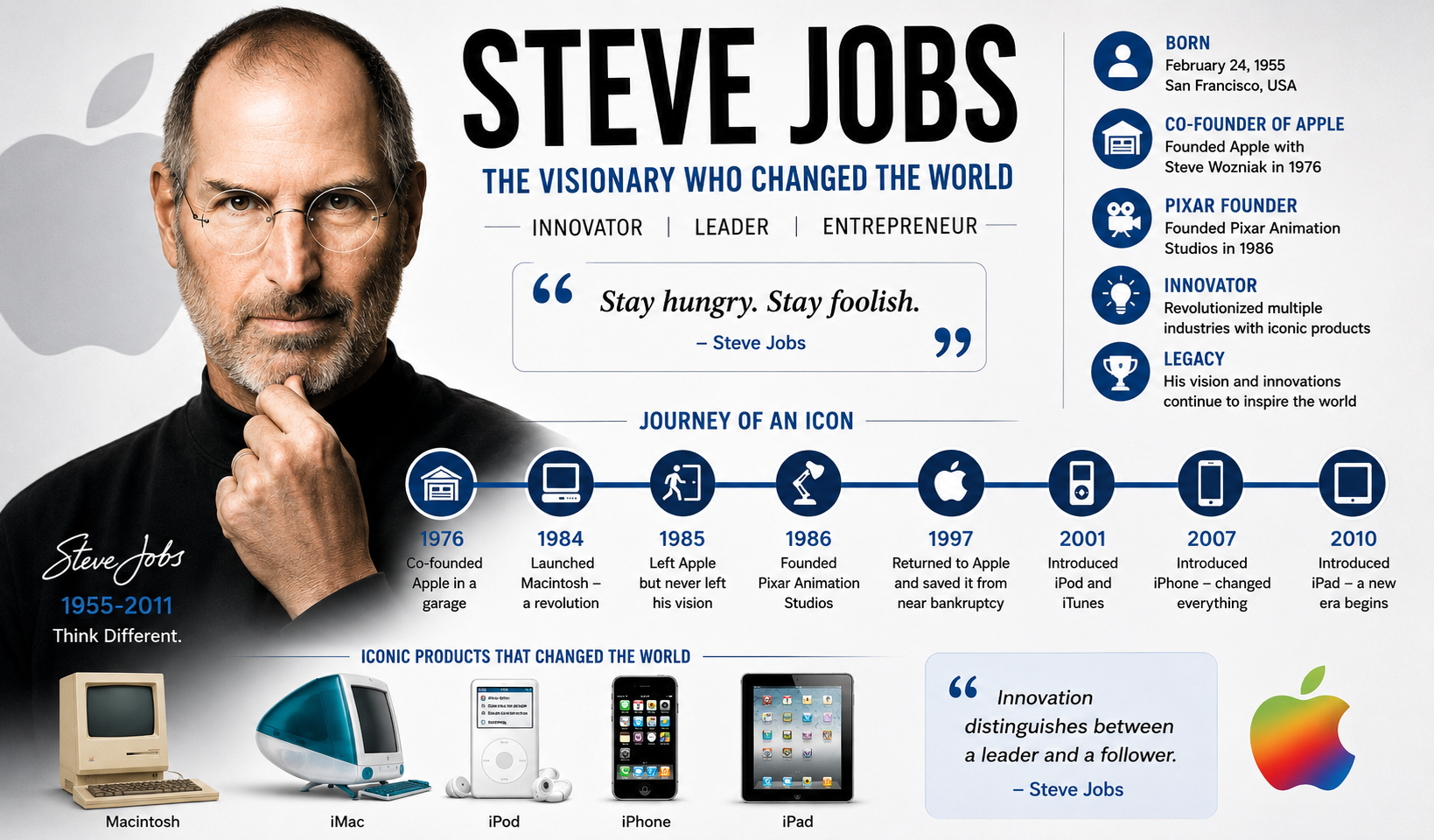
Steve Jobs Biography: The Visionary Who Changed the World with Apple
Steve Jobs was one of the greatest innovators and entrepreneurs in modern history. As the co-founder of Apple Inc., he revolutionized personal computing, smartphones, digital music, animation, and consumer electronics. His passion for design, innovation, and simplicity transformed the way billions of people use technology every day.
From creating Apple in a small garage to introducing groundbreaking products like the Macintosh, iPod, iPhone, and iPad, Steve Jobs inspired an entire generation of entrepreneurs and technology enthusiasts. His remarkable journey continues to motivate millions of people in the United States, the United Kingdom, India, and around the world.
Early Life
Steve Jobs was born on February 24, 1955, in San Francisco, California, USA. Shortly after his birth, he was adopted by Paul Jobs and Clara Jobs, who raised him in Mountain View, California.
Growing up in Silicon Valley, Steve developed a deep interest in electronics and engineering. His father taught him how to work with tools and build electronic devices, sparking a passion that would shape his future career.
As a teenager, Jobs attended meetings of the Homebrew Computer Club, where he met engineers and computer enthusiasts who inspired him to explore the rapidly growing world of personal computing.
Education
Steve Jobs graduated from Homestead High School in California and later enrolled at Reed College in Oregon.
Although he officially dropped out after just one semester due to financial difficulties, he continued attending classes that interested him, including calligraphy.
Years later, Jobs explained that the calligraphy lessons inspired Apple's beautiful typography and fonts on the Macintosh computer. This experience demonstrated his belief that learning from different fields could lead to groundbreaking innovation.
Founding Apple
In 1976, Steve Jobs, along with Steve Wozniak and Ronald Wayne, founded Apple Computer in Jobs' parents' garage.
Their first product, the Apple I, was a simple personal computer designed for hobbyists. It attracted attention because it was easier to use than many competing systems.
The real breakthrough came with the Apple II, which became one of the first highly successful mass-produced personal computers. Its popularity helped establish Apple as a major technology company and marked the beginning of the personal computer revolution.
The Macintosh Revolution
In 1984, Apple introduced the Macintosh, one of the first personal computers with a graphical user interface and a mouse.
Unlike traditional computers that required typing commands, the Macintosh allowed users to interact with icons and windows, making computers more accessible to everyday people.
Although initial sales were modest, the Macintosh changed the future of computing and influenced nearly every modern operating system.
Leaving Apple
Despite his success, Steve Jobs faced disagreements with Apple's board of directors and company executives.
In 1985, at the age of just 30, he left the company he had helped create.
Being forced out of Apple was one of the most difficult moments in his life. However, Jobs later described it as one of the best things that ever happened to him because it allowed him to start new ventures and explore fresh ideas.
Building NeXT and Pixar
After leaving Apple, Steve Jobs founded NeXT, a company focused on developing advanced computers for education and business.
Although NeXT was not a commercial success, its technology later became the foundation for Apple's modern operating systems, including macOS.
In 1986, Jobs purchased a small animation studio from Lucasfilm. He renamed it Pixar and invested heavily in its growth.
Pixar produced Toy Story in 1995, the world's first fully computer-animated feature film. The movie became a huge success and established Pixar as one of the world's leading animation studios.
Pixar later created many blockbuster films, including:
- Finding Nemo
- Monsters, Inc.
- The Incredibles
- Cars
- Up
- WALL-E
Returning to Apple
In 1997, Apple acquired NeXT, bringing Steve Jobs back to the company.
At the time, Apple was struggling financially and was close to bankruptcy.
Jobs quickly reorganized the company by simplifying its product lineup, improving product quality, and focusing on innovation.
His return marked one of the greatest business turnarounds in history.
Transforming Technology
Under Steve Jobs' leadership, Apple introduced products that changed multiple industries.
iMac
The colorful iMac combined attractive design with user-friendly technology, helping Apple regain popularity.
iPod
Launched in 2001, the iPod revolutionized digital music by allowing users to carry thousands of songs in their pockets.
iTunes
Apple's iTunes Store transformed the music industry by making it easy to purchase songs legally online.
iPhone
In 2007, Steve Jobs introduced the iPhone, a product that completely changed the smartphone industry.
The iPhone combined a phone, music player, internet browser, and camera into one elegant device. It quickly became one of the most successful consumer products ever created.
App Store
The App Store created an entirely new economy where developers could build and sell mobile applications to millions of users worldwide.
iPad
In 2010, Apple launched the iPad, creating a new category of tablet computers for work, education, and entertainment.
Leadership Style
Steve Jobs was known for demanding excellence and paying close attention to every detail.
His leadership principles included:
- Focus on simplicity.
- Create products people love.
- Never compromise on quality.
- Combine technology with creativity.
- Think differently.
- Build products that solve real problems.
Although his management style was often described as demanding, it helped Apple become one of the world's most valuable companies.
Challenges
Steve Jobs faced many personal and professional challenges throughout his life.
These included:
- Being removed from Apple.
- Competition from Microsoft and other technology companies.
- Financial struggles during Apple's difficult years.
- A diagnosis of pancreatic cancer in 2003.
Despite these challenges, he continued leading Apple and introducing revolutionary products for several years.
Awards and Recognition
Steve Jobs received numerous honors during his lifetime and after his passing.
Some of his achievements include:
- National Medal of Technology (posthumously)
- Fortune's Greatest Entrepreneurs
- Time Magazine's Most Influential People
- Grammy Trustees Award
- Disney Board Member
His influence on technology and design continues to be recognized worldwide.
Life Lessons from Steve Jobs
Steve Jobs' life offers valuable lessons for entrepreneurs, students, and professionals.
Follow Your Passion
Jobs believed that people should love what they do because passion drives creativity and innovation.
Think Differently
He encouraged people to challenge traditional thinking and create products that change the world.
Focus on Quality
Rather than creating many average products, Jobs believed in building a few exceptional ones.
Never Give Up
Even after being fired from Apple, he continued innovating and eventually returned to make the company stronger than ever.
Keep Learning
His curiosity about design, typography, and technology helped create products that were both functional and beautiful.
Famous Quotes
Some of Steve Jobs' most inspiring quotes include:
"Stay hungry. Stay foolish."
"Innovation distinguishes between a leader and a follower."
"The only way to do great work is to love what you do."
"Your time is limited, so don't waste it living someone else's life."
Legacy
Steve Jobs left behind one of the greatest legacies in technology history.
His products changed how people communicate, work, learn, and entertain themselves. From smartphones and tablets to digital music and animated films, his influence can still be seen in everyday life.
Apple continues to be one of the world's most valuable companies, while Pixar remains a global leader in animation. Jobs' commitment to innovation, design, and user experience continues to inspire entrepreneurs and engineers worldwide.
Conclusion
Steve Jobs' journey from a curious young innovator to the co-founder of one of the world's most successful technology companies is one of the greatest entrepreneurial success stories ever told.
Despite setbacks, failures, and personal challenges, he never stopped believing in the power of innovation. His vision transformed Apple into a global technology leader and changed multiple industries forever.
Today, Steve Jobs remains an enduring symbol of creativity, determination, and excellence. His life reminds us that with passion, persistence, and the courage to think differently, it is possible to create products that change the world and leave a lasting impact on future generations.

Covering the latest in AI, agents and emerging tech from our global editorial team.
More from James →