

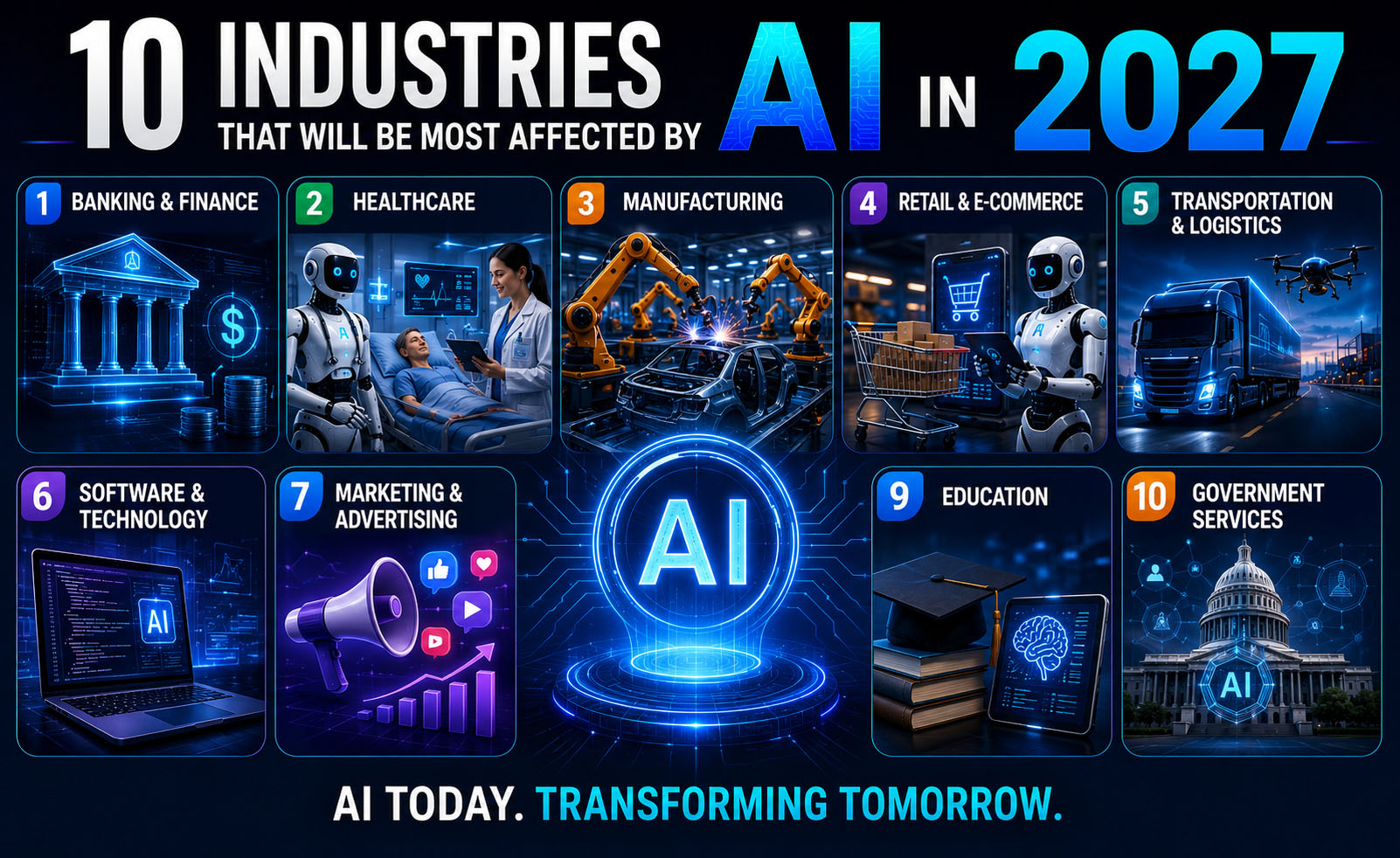
By 2027, artificial intelligence will no longer be an experimental tool sitting on the sidelines of business strategy — it will be embedded in how work actually gets done across the United States and the United Kingdom. Enterprise AI spending has already climbed sharply through 2026, and agentic AI systems — tools that can complete multi-step tasks with limited human oversight — are moving from pilot projects into daily operations across banking, healthcare, retail, and government.
For workers, business owners, and job seekers in the US and UK, understanding which industries face the most disruption isn't just useful — it's essential for career planning, hiring strategy, and investment decisions. Below is a breakdown of the 10 industries expected to see the deepest AI-driven change in 2027, along with the opportunities, the risks, and the trends shaping each one.
1. Banking, Financial Services & Insurance (BFSI)
Financial services remains the single most AI-exposed sector on both sides of the Atlantic. Analysis from the IMF has identified banking as having the highest share of work hours with high automation potential of any sector, and agentic AI already accounts for the overwhelming majority of new automation activity within finance and insurance. In the UK, financial services is one of the leading sectors for enterprise AI adoption, trailing only IT and telecoms.
Opportunities: Faster fraud detection, automated underwriting, real-time risk modeling, and AI-assisted financial advice for retail customers.
Challenges: Displacement of back-office, compliance, and entry-level analyst roles; regulatory scrutiny from the SEC, FCA, and Bank of England over AI-driven decision-making; algorithmic bias in lending.
2027 Trend: Expect "AI co-pilots" for financial advisors and loan officers to become standard rather than optional, with human oversight required for high-stakes decisions under emerging US and UK financial regulation.
2. Legal Services
Generative AI adoption has already reshaped a large share of legal work in the United States, with contract review, legal research, and document drafting increasingly automated. UK law firms are showing similarly high adoption, second only to IT and telecoms among all sectors measured.
Opportunities: Dramatically faster contract review, e-discovery, and legal research; lower-cost legal services for small businesses and individuals.
Challenges: Junior associate and paralegal roles built around research and drafting are the most exposed; concerns about AI "hallucinations" in filings have already triggered sanctions in US and UK courts.
2027 Trend: Law firms will formalize AI governance policies, and "AI-literate lawyer" will become a distinct hiring category.
3. Healthcare
Healthcare adoption has accelerated faster than almost any other sector, climbing from roughly a third of organizations in 2024 to well over half by 2026, driven by clinical AI breakthroughs and clearer regulatory pathways in both countries. Despite this, healthcare — alongside retail and education — still lags overall adoption in the UK relative to its potential, largely due to workforce shortages and data governance hurdles rather than lack of demand.
Opportunities: AI-assisted diagnostics and medical imaging, reduced administrative burden on doctors and nurses, drug discovery acceleration, and remote patient monitoring — all valuable in a sector facing chronic staffing shortages in both the NHS and US health systems.
Challenges: Liability questions when AI contributes to a misdiagnosis, patient data privacy under HIPAA (US) and UK GDPR, and clinician trust and training gaps.
2027 Trend: AI will shift from "pilot diagnostic tool" to embedded clinical workflow assistant, particularly in radiology, pathology, and administrative documentation.
4. Retail & E-commerce
Retail AI adoption has grown rapidly, with a large majority of retailers now using some form of AI automation, even though UK retail specifically still reports below-average enterprise adoption relative to other sectors.
Opportunities: Personalized recommendations, dynamic pricing, AI-powered inventory forecasting, and conversational shopping assistants.
Challenges: Continued erosion of frontline cashier, customer service, and warehouse roles; growing consumer wariness of AI-driven pricing and chatbots replacing human support.
2027 Trend: Agentic shopping assistants that can compare, negotiate, and complete purchases on a customer's behalf will move from novelty to mainstream in both US and UK e-commerce.
5. Manufacturing
Manufacturing has seen a sharp jump in smart-operations investment, with adoption climbing significantly through 2026 as factories deploy AI for predictive maintenance and quality control. Notably, a higher share of manufacturing job postings now require AI skills than in some more AI-exposed sectors like financial services, reflecting how deeply AI is being embedded into physical operations.
Opportunities: Predictive maintenance reducing downtime, AI-driven quality inspection, supply chain optimization, and safer human-robot collaboration on factory floors.
Challenges: Mid-skill technician and quality-control roles face restructuring; smaller manufacturers in both the US Midwest and UK regions risk falling behind larger, better-capitalized competitors.
2027 Trend: "AI-augmented" factory floors combining human oversight with autonomous robotics will become a competitive differentiator rather than a luxury.
6. Transportation, Logistics & Automotive
The automotive sector has seen a substantial rise in machine learning adoption for design, safety systems, and manufacturing. Autonomous vehicle technology remains one of the technologies technologists expect AI to influence most heavily through 2026 and beyond.
Opportunities: Route optimization, predictive fleet maintenance, safer advanced driver-assistance systems, and warehouse automation.
Challenges: Long-haul and delivery driving roles face long-term pressure as autonomous technology matures, though full driverless trucking remains further out than some predictions suggested; regulatory approval in the UK and across US states remains fragmented.
2027 Trend: Expect continued expansion of AI in logistics planning and warehouse robotics well ahead of full driving automation, which will still be limited to specific routes and regions.
7. Technology & Software Development
Unsurprisingly, the technology sector itself shows the highest AI adoption of any industry, with software leading global AI market share and the vast majority of developers now using AI coding tools in their daily workflow. Technology, media, and telecoms also lead all sectors in AI-related hiring intensity.
Opportunities: Massive productivity gains in coding, testing, and deployment; new categories of jobs in AI oversight, prompt engineering, and AI systems management.
Challenges: Junior developer roles centered on routine coding tasks are increasingly automated; several major US tech firms have already cited AI efficiency gains when announcing workforce reductions.
2027 Trend: "AI-native" engineering teams — smaller, augmented by autonomous coding agents — will become the norm at both startups and large tech employers in Silicon Valley and London's tech corridor.
8. Marketing, Media & Advertising
Generative AI has reached near-saturation in marketing, with the large majority of marketers now using it in at least one part of their workflow, from content generation to ad targeting and campaign testing.
Opportunities: Rapid content production, hyper-personalized advertising, AI-assisted video and design, and real-time campaign optimization.
Challenges: Entry-level copywriting, graphic design, and media-buying roles are under pressure; growing consumer fatigue with AI-generated content is prompting some brands to market "human-made" content as a premium feature.
2027 Trend: Expect clearer labeling standards for AI-generated advertising content in both the US (FTC guidance) and UK (ASA rules) as regulators respond to consumer concerns.
9. Education
Education shows comparatively lower enterprise AI adoption in the UK relative to its potential, similar to retail and healthcare, even as demand for AI tutoring and administrative tools grows.
Opportunities: Personalized learning paths, AI teaching assistants for grading and lesson planning, and expanded access to tutoring for underserved students in both countries.
Challenges: Concerns about academic integrity and over-reliance on AI tools among students; teacher training and school-level infrastructure are lagging demand; core teaching roles are considered relatively resistant to full automation given their relational nature.
2027 Trend: Schools and universities in the US and UK will move from banning AI tools to building formal AI-literacy curricula and usage policies.
10. Government & Public Services
Public sector organizations in both countries are actively restructuring roles around AI rather than simply adding headcount, particularly in administrative, casework, and citizen-service functions.
Opportunities: Faster processing of benefits claims, permits, and public inquiries; AI-assisted fraud detection in public spending; improved cybersecurity for critical infrastructure.
Challenges: Public trust concerns around AI in decision-making (welfare eligibility, policing, immigration); slower procurement cycles and legacy IT systems limit how fast government agencies can modernize compared to the private sector.
2027 Trend: Expect expanded but tightly governed use of AI in administrative government functions, with explicit human review requirements written into policy in both the US and UK.
US vs UK: How AI Adoption Compares by Sector
| Sector | Leading Market | Notes |
|---|---|---|
| Financial Services | US (higher investment) | UK close behind; both increasing regulatory scrutiny |
| Legal | Comparable | High adoption in both; UK legal sector among its top adopters |
| Healthcare | US (faster private adoption) | UK adoption slower due to NHS procurement and data governance |
| Retail | US | UK retail adoption lags relative to its potential |
| Manufacturing | Comparable | Strong growth in both; regional gaps within each country |
| Technology | US | Silicon Valley leads, though London remains a major AI hub |
| Government | Comparable | Both moving cautiously with governance-first approaches |
Frequently Asked Questions
Which industries will AI affect the most by 2027?
Banking and financial services, healthcare, legal services, retail, manufacturing, transportation, technology, marketing, education, and government are expected to see the most significant AI-driven change by 2027 in both the US and UK.
Will AI eliminate more jobs than it creates by 2027?
Forecasts vary, but most major bodies — including the World Economic Forum and IMF — project both substantial displacement and substantial job creation, with the net effect depending heavily on how quickly workers and employers adapt.
Is the UK or US ahead in AI adoption by industry?
The US generally leads in enterprise AI adoption and investment overall, especially in technology and financial services, while the UK is closing the gap in financial and professional services. Retail, healthcare, and construction lag in both countries.
What should workers do to prepare for AI disruption in their industry?
Focus on skills AI complements rather than replaces — judgment, relationship management, creative strategy, and oversight of AI systems — and build hands-on familiarity with the AI tools already used in your field.